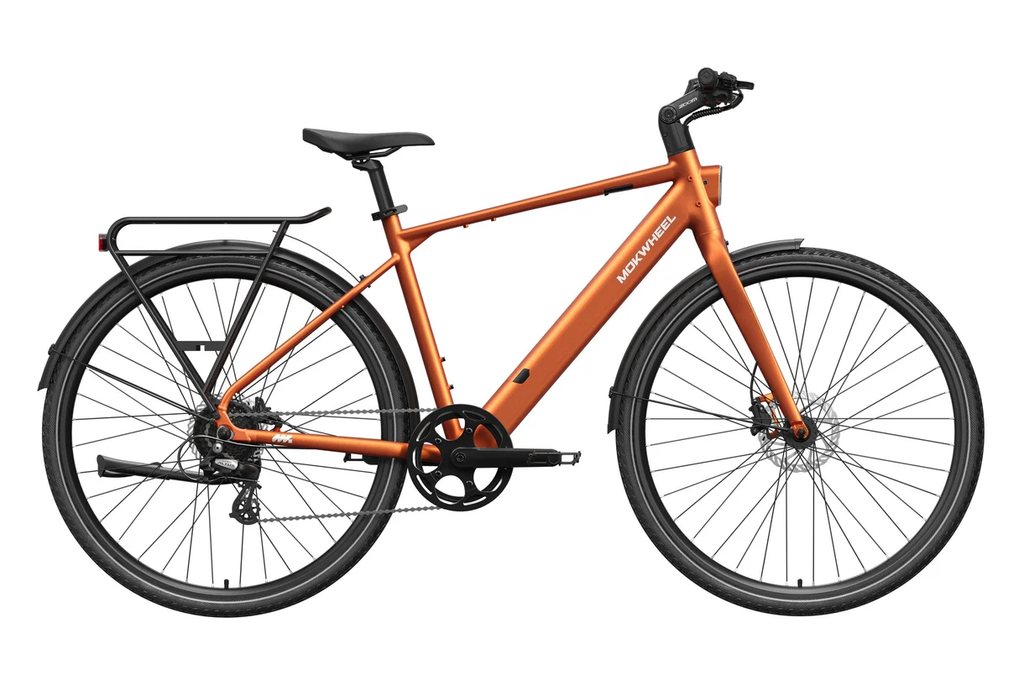
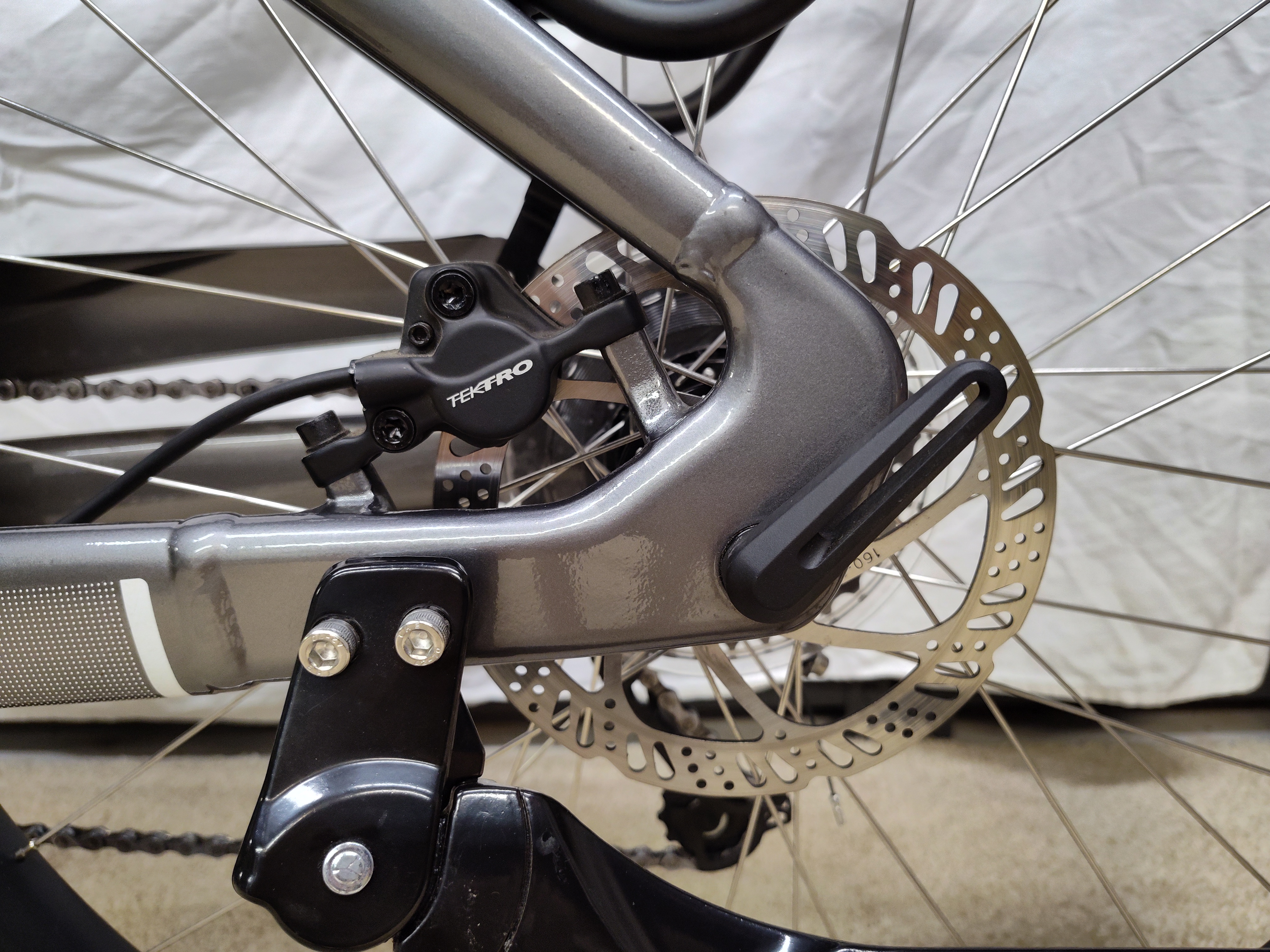
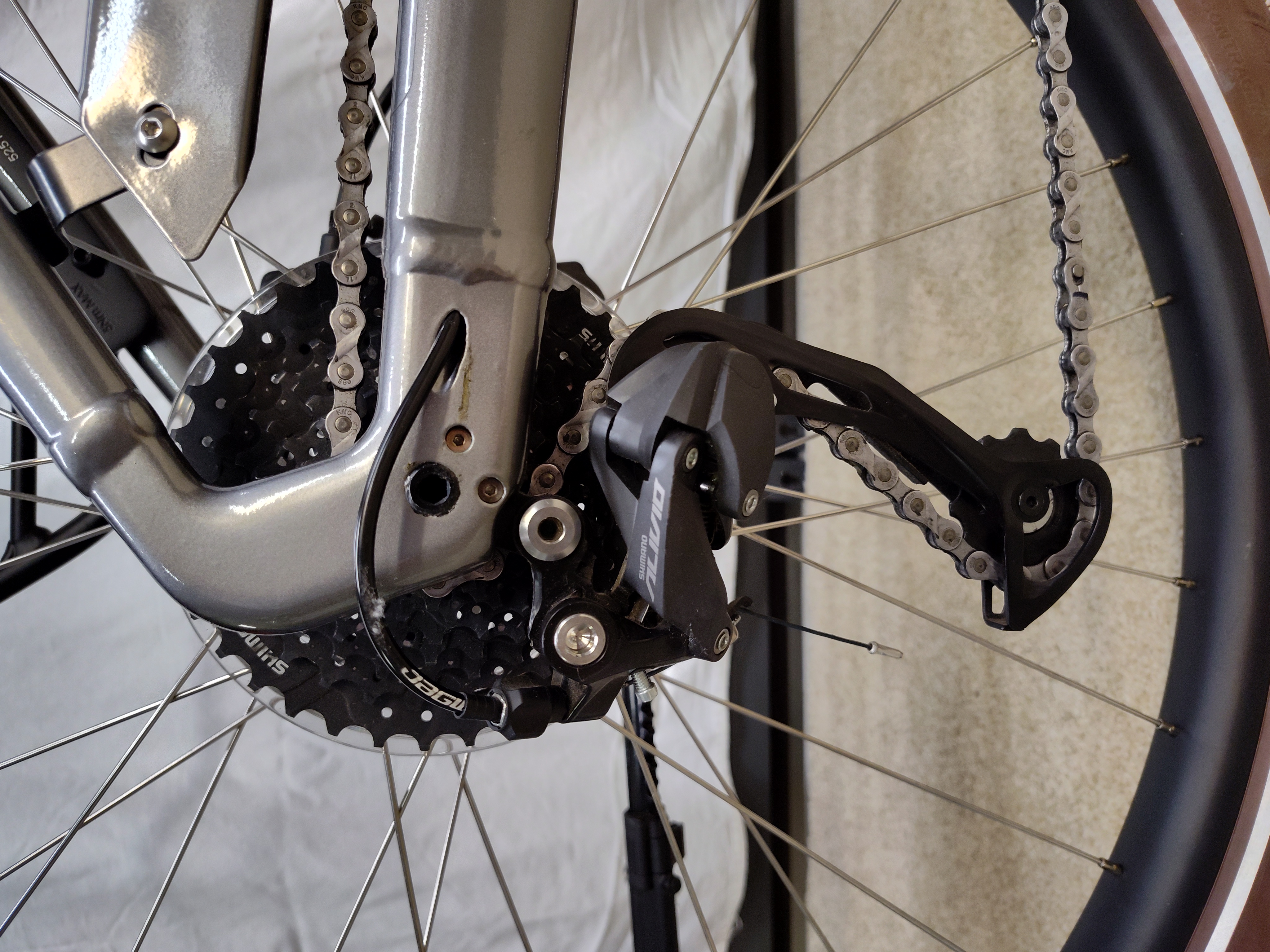
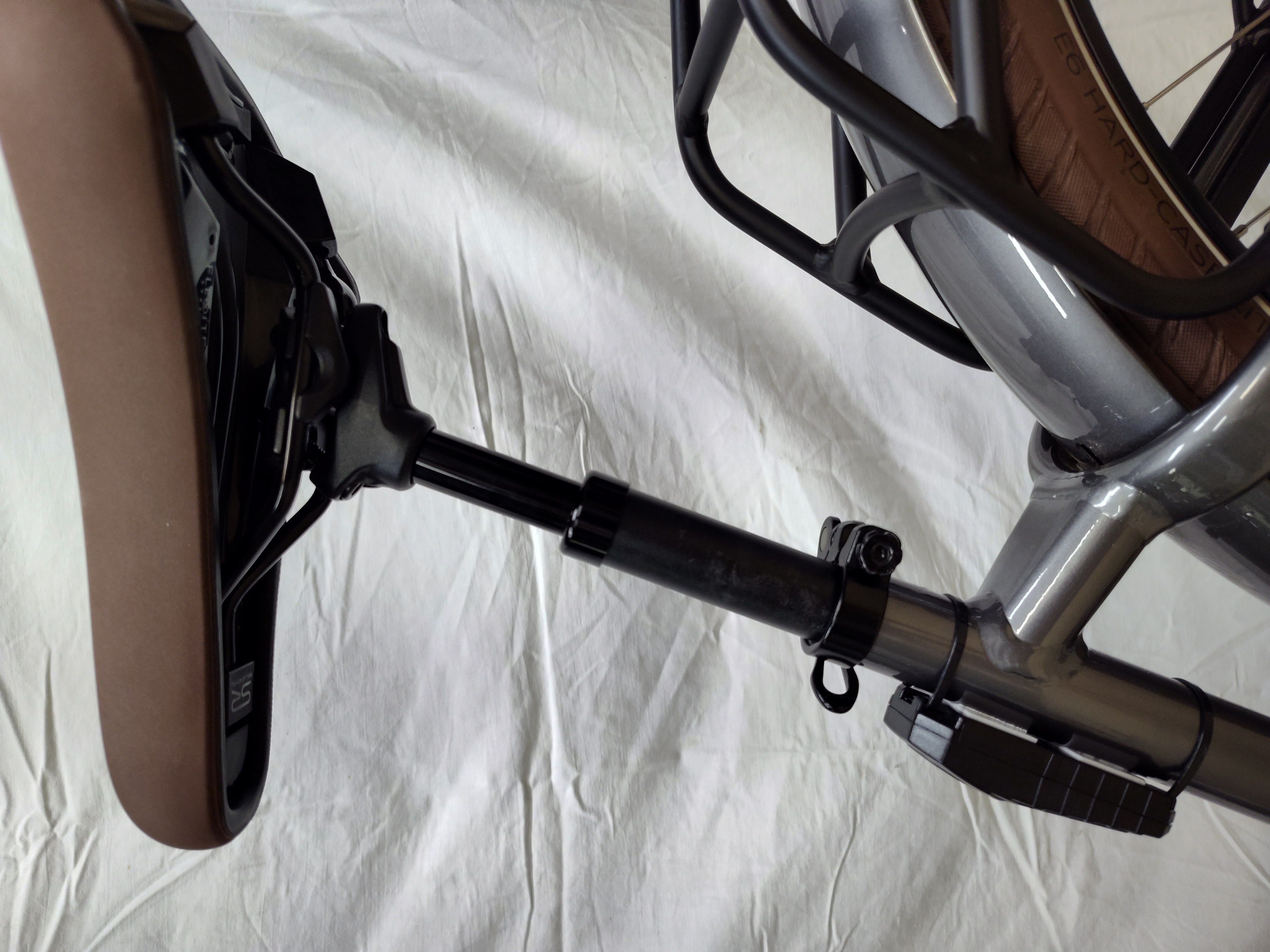
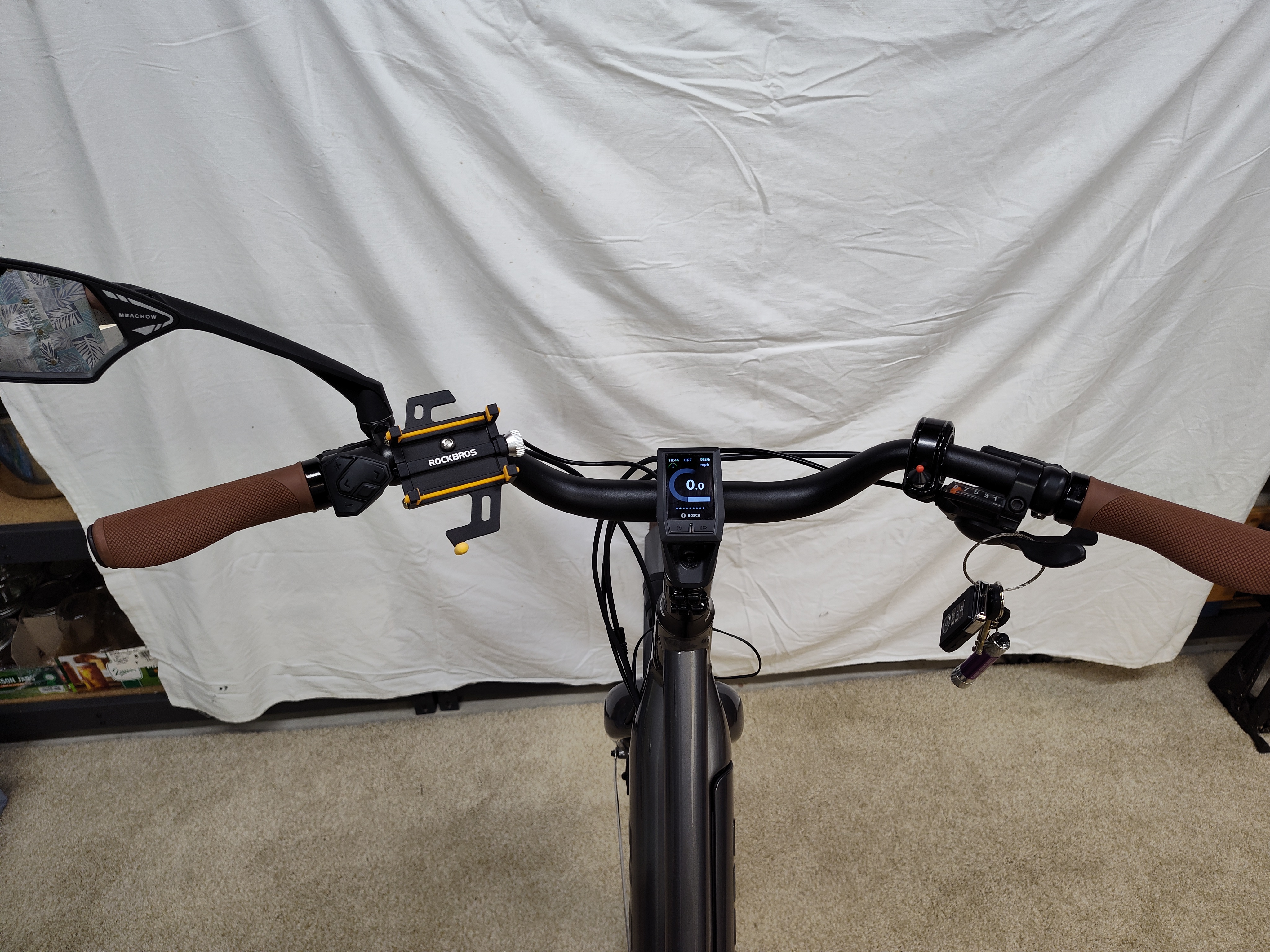
I bought this e-bike a while ago and since I have so many other ‘favorite’ e-bikes to ride, the Mokwheel Flint didn’t get any respect until a couple days ago. Here’s a picture of my Flint:
And some specs:
36 lbs
350W motor (550W peak)
40Nm of torque
36V 10Ah battery
30 to 50-mile range
20 mph
Shimano 8-speed drivetrain
Logan hydraulic brakes
700x45C tires
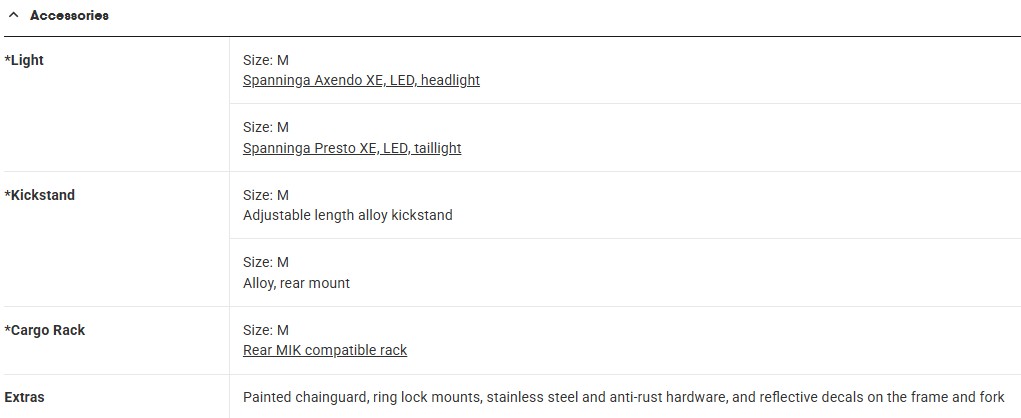
Fenders and rack are included
This bike has a torque pedal assist system, no throttle, and technically is about as basic (and light) as an e-bike can be, AND I LOVE IT! Of course a 350w e-bike is not going to be a hill-climber, but the power range and assist one gets from the motor is phenomenal! It feels and rides like a regular bicycle, but the assist is everywhere you need it. And power delivery is smooth and completely silent. This bike is just really fun to ride and I highly recommend it for those coming from a regular men’s bicycle to an e-bike for the first time, and for those just looking for a lightweight, simple and legal (almost) everywhere e-bike.
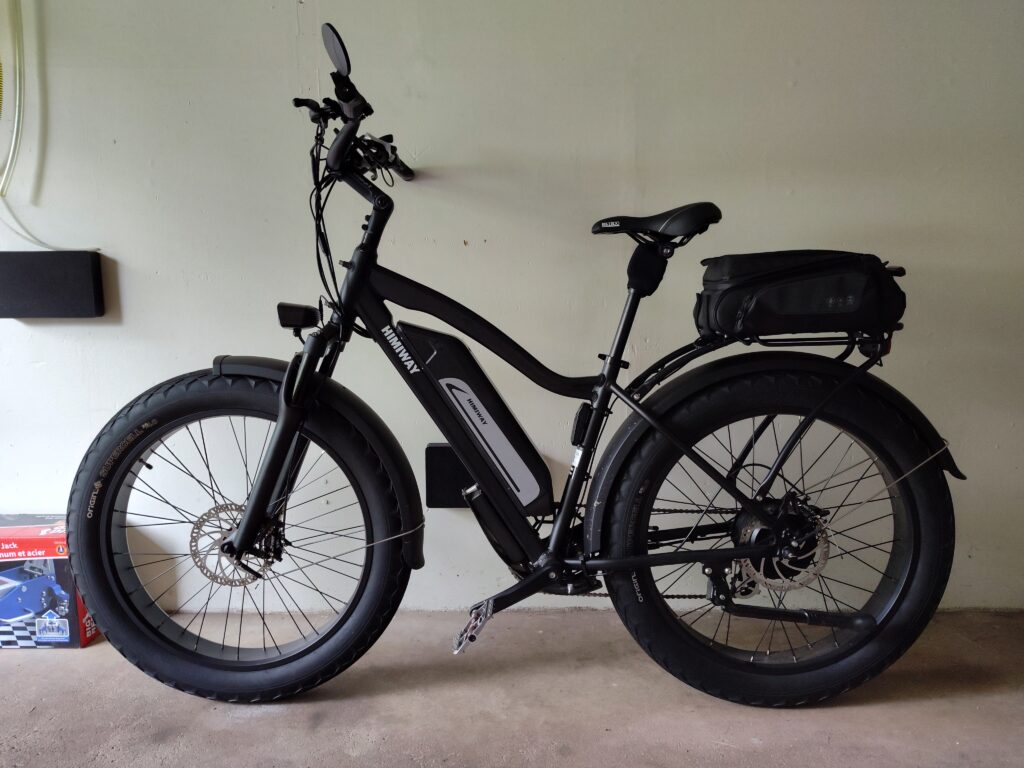
As mentioned, I have only been riding the Flint for a couple days, so this was my first experience with battery range. The battery is small (and light) by e-bike standards, but during my 3 rides I started at 98% charge. 11 miles later it was at 88%. Another 11 miles took it to 77%, then a finel 11 mile ride left me with 35% battery. I don’t think I can squeak another 11 miles out of it, but I can safely say this is a 40 mile battery in hilly Pennsylvania terrain. And the bike is so light and well mannered that you’ll just want to pedal whenever you can anyway. This is quiet a different experience than my Himiway Cruiser which isn’t a bicycle at all. I would die trying to pedal the Himiway withour a motor, but to its credit, it’s got a really big (and heavy) battery. I would put the Flint and the Cruiser at opposite ends of the e-bike spectrum, though I have to say they each have their place and I really enjoy both.
Anyway, I wanted to write this piece because the Flint really surprised me how good it actually is. Out of the box, the Flint is complete for most riders. My mods after purchase included:
E-bike laws are being written that make no sense at all.
But let’s start with Federal Law:
At the federal level, a 2002 law enacted by Congress, HB 727, amended the Consumer Product Safety Commission definition of e-bikes. The law defined a low-speed electric bicycle as “A two- or three-wheeled vehicle with fully operable pedals and an electric motor of less than 750 watts (1 hp), whose maximum speed on a paved level surface, when powered solely by such a motor while ridden by an operator who weighs 170 pounds, is less than 20 mph.” The federal law permits e-bikes to be powered by the motor alone (a “throttle-assist” e-bike), or by a combination of motor and human power (a “pedal-assist” e-bike).
Editorial Comment: Makes sense. No issue here.
And Pennsylvania State Law:
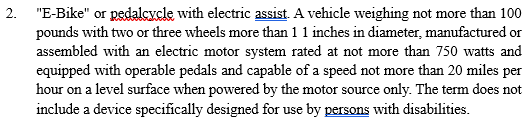
At the Pennsylvania state level (2014 Act 154), “Pedalcycle with electric assist.” A vehicle weighing not more than 100 pounds with two or three wheels more than 11 inches in diameter, manufactured or assembled with an electric motor system rated at not more than 750 watts and equipped with operable pedals and capable of a speed not more than 20 miles per hour on a level surface when powered by the motor source only.
In addition, e-bikes “do not require a certificate of inspection or insurance” and “are afforded ALL of the rights and responsibilities of other bicycles under PA law”. PENNSYLVANIA E-BIKE LAW handout.
Editorial Comment: Makes sense. No issue here. Sounds a lot like the Federal Law.
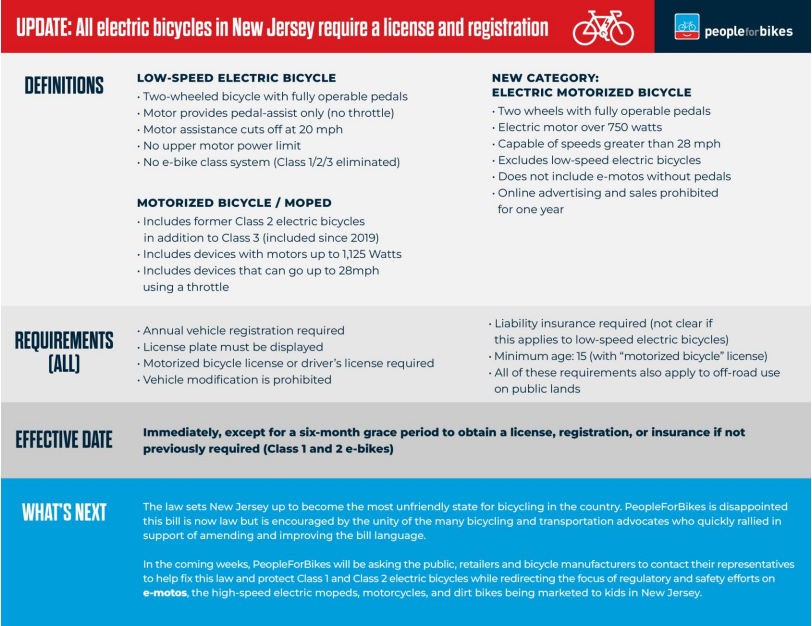
But what just happened in New Jersey?
As of January 19, 2026, New Jersey has enacted the nation’s most restrictive e-bike laws, requiring registration, insurance, and a driver’s (or specialized) license for most e-bikes. Signed by Governor Phil Murphy, the law reclassifies Class 2 and 3 e-bikes as “motorized bicycles”.
Key Aspects of the New Jersey E-Bike Law (2026):
Licensing & Age: Riders must be at least 15 years old and possess a valid driver’s license or a specialized “motorized bicycle” license (requires a written/vision/road test). Riders under 15 are prohibited from riding on public property.
Registration & Insurance: All e-bikes must be registered with the Motor Vehicle Commission. Class 2 and 3 e-bikes require liability insurance.
Helmets: DOT-approved helmets are mandatory for Class 3 riders and anyone under 17.
Restrictions: The law prohibits riding on sidewalks and generally bans them on natural surface trails. It also mandates safety equipment like lights and a horn.
Upcoming Deadlines:
July 20, 2026: Deadline to register your e-bike. The first year of registration is free.
New Jersey’s E-Bike Law: What Retailers and Riders Need to Know About S4834
Editorial Comment: These restrictions are ridiculous, uninformed, and incredibly destructive to e-bike businesses in NJ and to tourism. And they do little to actually fix known abuses among e-bike riders which create enforcement and safety issues.
And now California is joining the ranks of the crazy lawmakers.
As of May 2026, California is strictly regulating e-bikes by enacting mandatory rear lights/reflectors, and enforcing a 750W motor cap. Key changes include mandatory labeling, potential registration/license plates (under proposed AB 1942), and retailer accountability. Here’s a summary of AB 1942:
California Assembly Bill 1942 (AB 1942), introduced by Assembly member Rebecca Bauer-Kahan and referred to as the “E-Bike Accountability Act,” is a piece of proposed legislation in the 2025–2026 session aimed at increasing oversight of electric bicycles.
Core Provisions
If passed in its current form, AB 1942 would:
Mandate Registration: Require owners of Class 2 and Class 3 electric bicycles to register their bikes with the California Department of Motor Vehicles (DMV).
Require License Plates: Mandate the display of a special license plate issued by the DMV on these bicycles.
Proof of Ownership: Require riders to carry documentation verifying ownership that matches the bike’s serial number.
Enforcement: Establish an “Electric Bicycle Registration Fund” to manage the program and allow law enforcement to issue fines for non-compliance.
Stated Purpose
The bill’s proponents, including Assemblymember Bauer-Kahan, argue that the measure is a necessary public safety response to the significant rise in e-bike-related injuries and the challenges police face in holding reckless riders accountable. Supporters contend that visible plates and a registry would improve accountability and help law enforcement identify riders who violate traffic laws.
Key Criticisms and Opposition
The bill has faced significant opposition from cycling advocacy groups (such as CalBike and Bike East Bay) and community members. Opponents raise several primary concerns:
Focus on the Wrong Target: Critics argue the bill punishes users of legal, standard e-bikes rather than addressing the real issue: high-powered, illegal “e-motos” (electric motorcycles or mopeds mislabeled and sold as e-bikes) that often lack necessary safety equipment.
Barrier to Sustainability: Opponents claim the additional costs and bureaucracy will discourage the use of e-bikes, which are seen as a vital, low-emission alternative to cars.
Risk of Biased Policing: Critics warn that registration and license plate requirements could lead to an increase in pretextual, discriminatory police stops, noting that California previously moved to abolish local bike registration laws specifically to reduce such incidents.
Impracticality: Opponents argue the requirements are logistically burdensome, as bicycles were not designed with mounts for license plates, and the administrative cost of the program may outweigh its benefits.
Current Status
As of late April 2026, the bill has passed through committee and was re-referred to the Committee on Appropriations.
California Assembly Bill 1557 (AB 1557), introduced by Assembly member Diane Papan in the 2025–2026 session, proposes significant changes to how electric bicycles (e-bikes) are defined and regulated in California.
The bill is often discussed alongside AB 1942, but while AB 1942 focuses on registration and licensing, AB 1557 focuses on the technical specifications and speed limits of the bikes themselves.
Key Provisions
Lower Speed Limits: The bill would reduce the maximum assisted speed for Class 1 and Class 2 e-bikes from 20 mph to 16 mph.
Motor Power Caps: It prohibits manufacturers and retailers from selling Class 1 or Class 2 e-bikes with motors exceeding 250 watts of continuous power and 750 watts of peak power.
New “Cargo E-Bike” Category: Recognizes “cargo electric bicycles” as a specific category, allowing them slightly more motor power (up to 750 watts continuous) to account for the heavier loads they carry.
Age Restrictions: Prohibits anyone under the age of 16 from operating an e-bike with a motor exceeding 250 watts of continuous power.
Enforcement & Penalties: Grants law enforcement the authority to impound non-compliant bicycles. Manufacturers or retailers in violation could face civil penalties ranging from $15,000 to $50,000.
Arguments for the Bill
Supporters, including some local government officials and safety advocates, argue that:
Public Safety: Lowering speeds to 16 mph reduces the severity of accidents, particularly in high-traffic pedestrian areas and school zones.
Clarity for Law Enforcement: By setting strict wattage and speed caps, it helps police distinguish between legal e-bikes and “e-motos” (high-powered electric motorcycles) that are currently being sold as e-bikes.
Arguments Against the Bill
The bill has met strong opposition from cycling advocacy groups (like CalBike) and major manufacturers (like Trek), who argue:
Infrastructure Mismatch: Critics point out that California’s current “Three-Class” system is the national standard used in 45 states; breaking away from it would create a confusing “California-only” market.
Safety Irony: Some argue that forcing e-bikes to go slower than 20 mph makes them less safe because it increases the speed differential between cyclists and cars in shared traffic.
Economic Impact: The bill could effectively ban many popular e-bikes currently on the road, hurting both retailers and commuters who rely on them.
Current Status
As of May 2026, AB 1557 is currently moving through the legislative process. It was recently referred to the Assembly Appropriations Committee “suspense file,” a common step for bills with significant fiscal impacts where they are held for further review before a final vote.
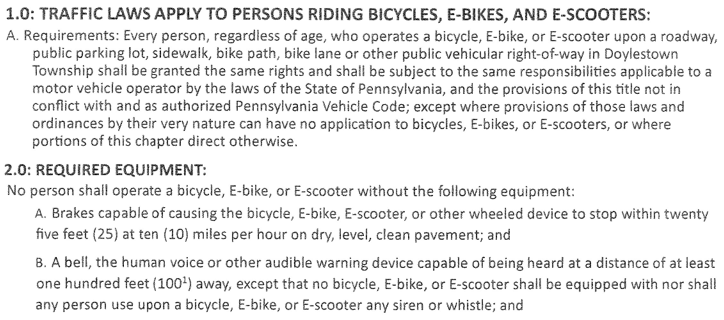
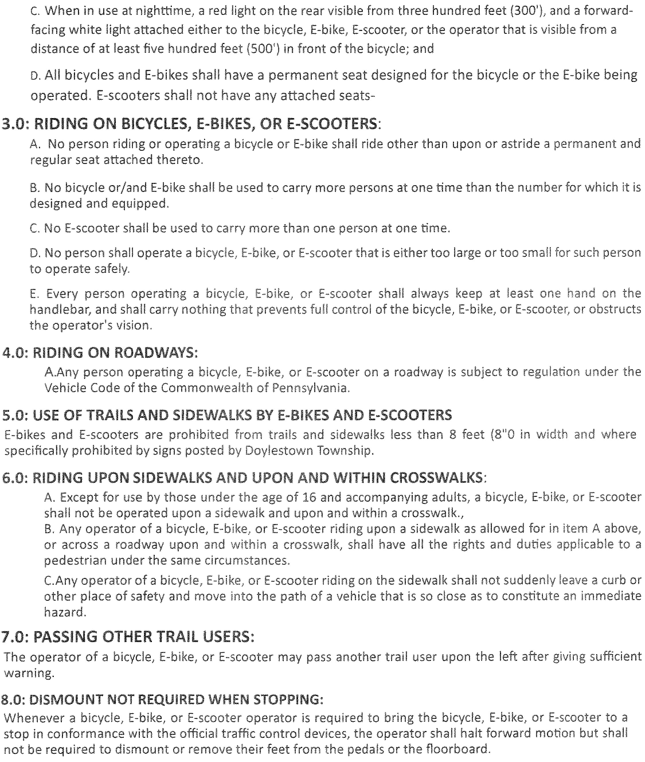
There’s an awful lot ink being spilled on the perceived issue of e-bike safety, and the craziness is not likely stop anytime soon. However, if you’re searching for some semblance of sanity with respect to this issue, one needs to look no further than my local community (Doylestown Township). Here’s what they have to say:
Ordinance NO. 432 (March 17, 2026), establishing Chapter 120, Bicycles, E-Bike and E-Scooters, to regulate the use of bicycles , E-Bikes and E-Scooters within Doylestown Township.
Where E-Bikes Are Permitted:
Allowed on Township trails, parks, and roadways
E-bikes and e-scooters are not permitted on trails less than 8 feet wide or where posted
Sidewalk use is generally not permitted, except for riders under 16 accompanied by an adult
Must have:
Working brakes
A bell or audible warning device
Lights/reflectors when used at night
Speed Limit:
Maximum speed is 15 mph on Township property, or lower as conditions require
Enforcement:
Enforced by Township Police
Fines: $100 for first violation, $250 for second violation, Up to $500 for future violations
Editorial Comment: Brief, to the point, enforceable, and it leans on existing PA and Federal laws which are reasonable. How is this not enough to deal with the problem at hand?
And Bucks County Park System Ordinance 170 from January 18, 2023 (Doylestown is aligned with this ordinance as they should be). From S7 Operation of Bicycles, E-bikes, and E-scooters:
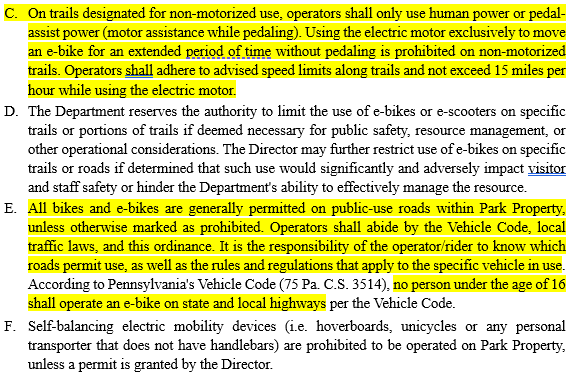
“C. On trails designated for non-motorized use, operators shall only use human power or pedal-assist power (motor assistance while pedaling). Using the electric motor exclusively to move an e-bike for an extended period of time without pedaling is prohibited on non-motorized trails. Operators shall adhere to advised speed limits along trails and not exceed 15 miles per hour while using the electric motor.”
Federal, PA, Bucks County, Doylestown Township – they’re all aligned, reasonable, and enforceable. This is all that’s needed and the way it should be!
Question: Where do e-bike batteries go when they die?
Answer: Not heaven.
I was pondering this issue this morning because no e-bike battery is going to live forever – not even close. In fact an e-bike owner can count of their battery to last between 3-5 years before it will need to be replaced. By that time your e-bike WILL be out of warranty, AND it’s possible the replacement battery for your particular e-bike might not even be available any longer since the e-bike model you purchased (and maybe even the company that made it) is no longer, which includes proprietary replacement parts like the battery case and electronics.
But that’s not really what this is all about. My question is where all these dead batteries go for their final resting place? Certainly not the landfill. That would be extremely dangerous! So here’s what I think the right answer is:
First, how many e-bike batteries are produced each year?
There is no single, universally reported global figure for annual e-bike battery production. The market is growing rapidly, with lithium-ion packs increasingly used in e-bikes, and industry analyses typically report revenue and market size rather than a precise unit count of batteries produced annually. Estimates vary by source and methodology, but the broader trend is a multi‑billion‑dollar battery market expanding year over year. One source claims that “more than 12 million e-bikes are expected to be sold in the U.S. between 2020 and 2030, requiring over 1.2 million new e-bike batteries annually to meet this demand.”
Second, how long will an e-bike battery last?
Typical e-bike lithium-ion batteries offer about 3 to 5 years of useful life under normal use, with performance largely depending on charging cycles, depth of discharge, temperature, and maintenance. Many brands quantify life in charge cycles (commonly around 500–1,000 full cycles) before noticeable capacity loss, which translates to several thousand miles of riding before replacement is commonly considered. Real-world lifespan can be longer with gentle usage and proper care, or shorter if abused or exposed to harsh conditions.
Third, where e-bike batteries go when they’re no longer viable (in the US)?
In the United States, end-of-life e-bike batteries typically enter a formal recycling or proper disposal stream rather than standard household trash. Industry programs have emerged to collect and route batteries to certified recyclers or material sorters. Programs coordinated by organizations like Call2Recycle (rebranding to The Battery Network) and industry groups have established nationwide drop-off networks through retailers and bike shops to channel batteries into recycling streams. However, challenges remain to achieve a comprehensive, seamless system: uneven participation across brands and retailers, variable state-level regulations, the need for specialized handling due to fire and safety risks, and the requirement for widespread consumer awareness and convenience. While programs exist and are growing, many stakeholders consider the current system still developing toward full coverage and consistency nationwide.
An ongoing industry effort has been building momentum around 52 participating brands and thousands of drop-off points, signaling strong progress toward broader e-bike battery recycling, but full nationwide coverage and standardized practices across all regions remain work in progress.
Another question I was pondering, and related to question 2 above, was “what factors determine e-bike battery longevity and performance?“
Charging habits: Frequent full charges, repeated deep discharges, and leaving a battery at very high or very low charge for long periods can accelerate wear.
Temperature: Heat speeds chemical aging, and cold temporarily reduces range and power output.
Riding style: Hard acceleration and constant high-assist use draw more current and reduce efficiency.
Terrain and load: Hills, headwinds, off-road riding, heavier riders, cargo, and accessories all make the motor work harder, which drains the battery faster.
Storage: Batteries stored for long periods at full charge, near empty, or in poor conditions tend to degrade faster.
Battery quality and age: Better cells and a good battery management system generally perform better, but all lithium-ion batteries lose capacity over time and with charge cycles.
Range is usually reduced fastest by high assist levels, steep climbs, cold weather, heavy loads, and frequent stop-and-go riding. In practice, a battery may still “work” after several years, but it will deliver less range than when new because usable capacity declines with age and cycles.
A good rule of thumb is that battery health is mostly about avoiding heat, deep discharge, and high current draw.
If not heaven, then what?
At the recycler, the battery is typically made safe first, then disassembled so cells, wiring, casing, and electronics can be separated. The recovered materials are then processed to reclaim valuable metals such as lithium, cobalt, nickel, and manganese for use in new products, including new batteries.
Use caution!
E-bike batteries should NOT go in household trash or regular recycling because lithium-ion packs can short-circuit and start fires if mishandled.
E-bike batteries are larger and more complex than many consumer batteries, so they need controlled collection, transport, and processing. That is why manufacturers and recycler networks emphasize certified drop-offs and trained handling instead of informal disposal.
Here’s the presentation I’ll be given to my class participants on April 14, 2026. It’s intended as an introduction to electric bicycles (aka e-bikes) and will cover topics including:
Below are two files I’m using for my ‘Hike & Bike Trails In Bucks and Montgomery Counties’ presentation to be given to Center for Learning in Retirement members during my March 24, 2026 virtual class. The approach I plan to take with this class is to help those interested in hiking or biking these trails to learn how to find the information they’ll need a) to choose a trail of interest, b) to get relevant information such as where to park, how difficult the trail will be for their particular situation, where food and bathroom stops might be, etc., and c) to print out maps and/or brochures to assist with their adventure when they get there.
In Bucks and Montgomery counties in Pennsylvania, we have many completed trails and more on the way, so many good options for those wanting to explore the natural beauty and rich history in this part of the world. Also during this presentation I plan to talk about something I’m keen on which is how ‘electric’ bicycle technology fits into the trails picture. I know there are some that think e-bikes are evil and have no place on our trails. But as an ‘older person’ presenting to individuals how might not be adventuring on these trails without the assistance of e-bike technology, I believe I owe to my listeners to talk about e-bikes in the context of our local trail systems. And for those specifically interested in e-bikes, here’s a link from a CLR presentation from 2024: All About Electric Bicycles
So for those wanting to read ahead before tomorrow’s Trails presentation, here are the two files I’ll be using. The first one is the actual presentation. The second is the script I’ll be using to demonstrate various web sites I’m referencing during the discussion. Note that there are many ‘active links’ (text you can click on to take you to specific web sites) throughout the presentation you can click on to get more information. I’ll go over all this during the presentation, so not to worry if this is a bit confusing now. I guarantee it will be more so by the time I’m done!
Matt‘s reviews are always great to watch, but in this particular video he made one comment about this e-bike that made me think more about a feature every ebike on the market today should include – but I’ll digress for a moment…
The thing is, when I ride I’m always in one of 3 (e-bike) modes.
Mode 1 – get to the trail, which usually includes some riding on busy streets. There I want power and speed (Class 3)
Mode 2 – I’m on the trail, and if allowed I’ll use throttle when necessary. I find throttles to be not only very useful, but also an essential safety feature. Municipalities that ban throttles most likely don’t include e-bike riders on the committees that make such decisions. Anyway, this mode drops the max speed from 28 to 20mph and is a Class 2 e-bike (considered under Federal and PA state law as a regular bicycle).
Mode 3 – Some trails that allow e-bikes don’t permit the use of throttles (PAS only). This is considered a Class 1 e-bike, also with a 20mph cap for power-assist delivered while pedaling.
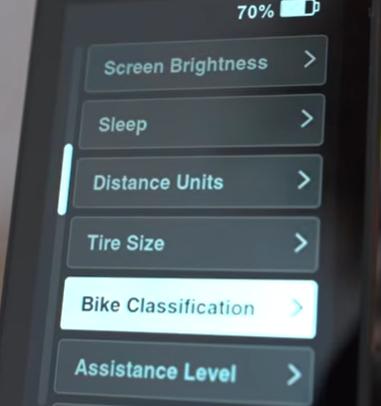
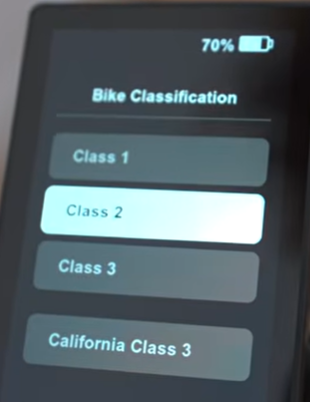
So here’s that Lectric decided to do – keeping it simple AND legal. What a great idea! So on their display they have this setting (Bike Classification):
And within Bike Classification, you can dial in the class you want/need to ride for each of the modes listed above – genius (and simple)! Note: In California, “Class 3” refers to a specific type of electric bike (e-bike) that is pedal-assist only, with a maximum assisted speed of 28 mph.
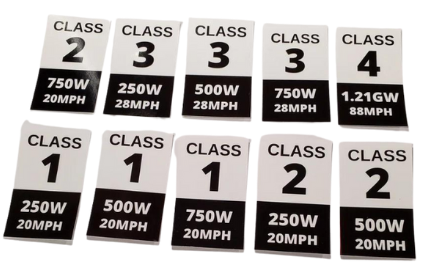
But here’s another issue our Lectric e-bike rider might experience. Having set the Bike Classification appropriate for a given trail, the trial ‘police’ might still stop you and check out the Class-ification badge each e-bike is supposed to display – yeah, these things:
This is a conumdrum, but my solution (and recommendation) is to display the lowest class rating – in this case Class 1 750w 20mph which will be a get out of jail sticker for every occassion. You can tell the arresting officer I told you so… see how far that gets ya.
Keeping it simple (and legal) is a good thing for most e-bike riders, and I think Lectric has figured this out and provides a solution that works. Good on ya, Lectric!
Posted inUncategorized|Comments Off on Lectric XP4 750 got me thinkin’
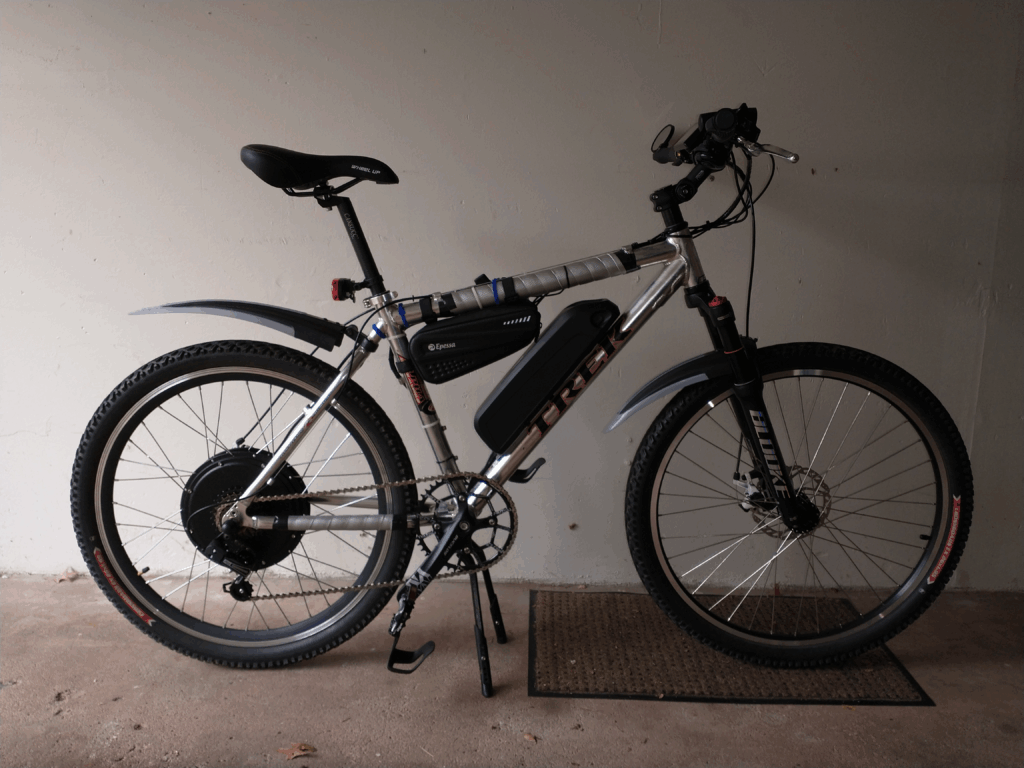
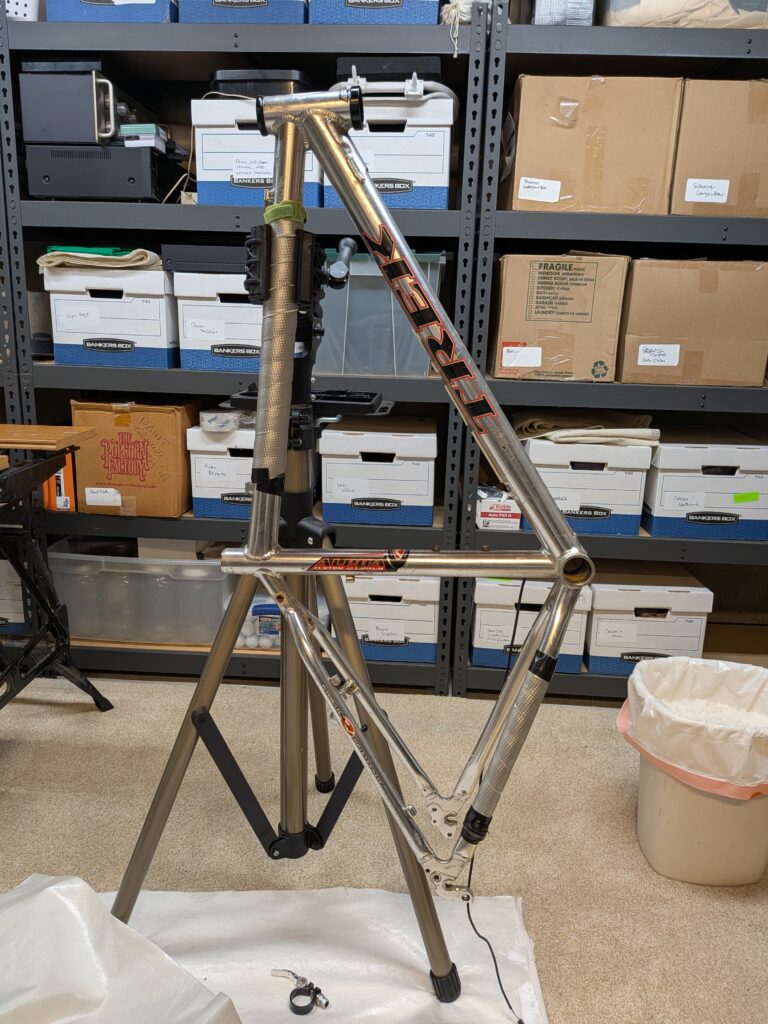
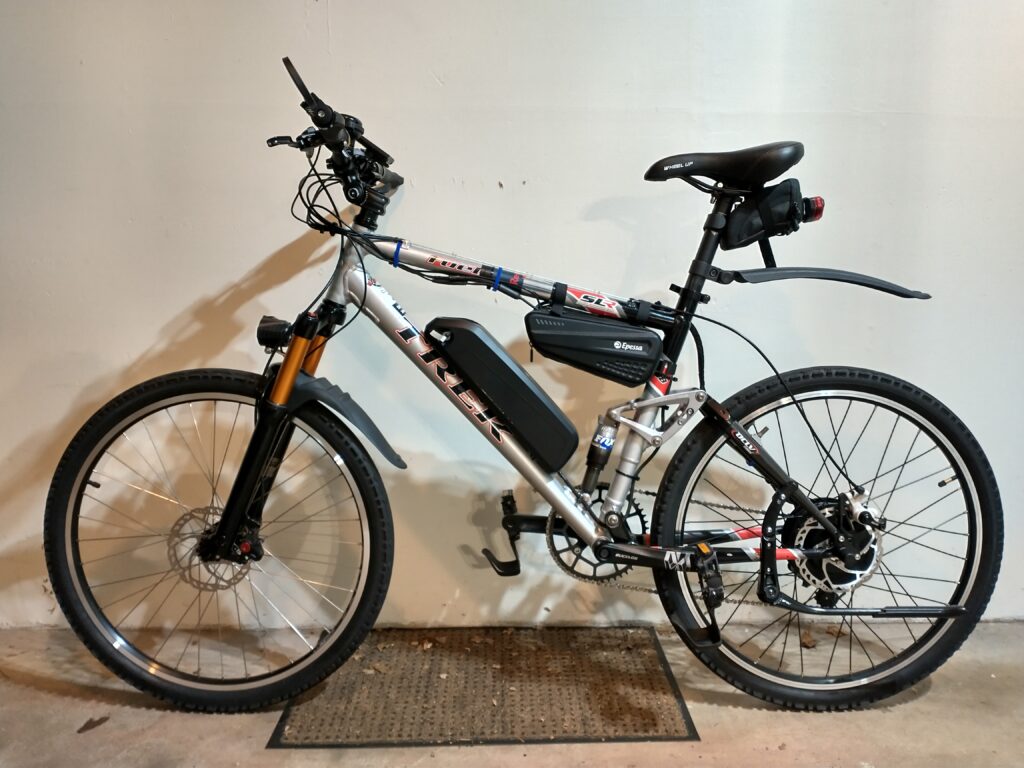
Way back in 2022, I bought a Trek frame for $80 and built a nice e-bike using a Voilamart brushless, gearless 1000w motor.
Then over the years I built other e-bikes and basically relegated the bargain Trek frame to the dust bin. However, as e-bike builders soon discover, we have many spare parts lying around which could end up being part of a new ‘rat’ e-bike. And in this case, my ‘reborn’ creation is being called Frankie since it is truly a Frankenstein bike, brought back from the dead, using bits and pieces from several previous builds.
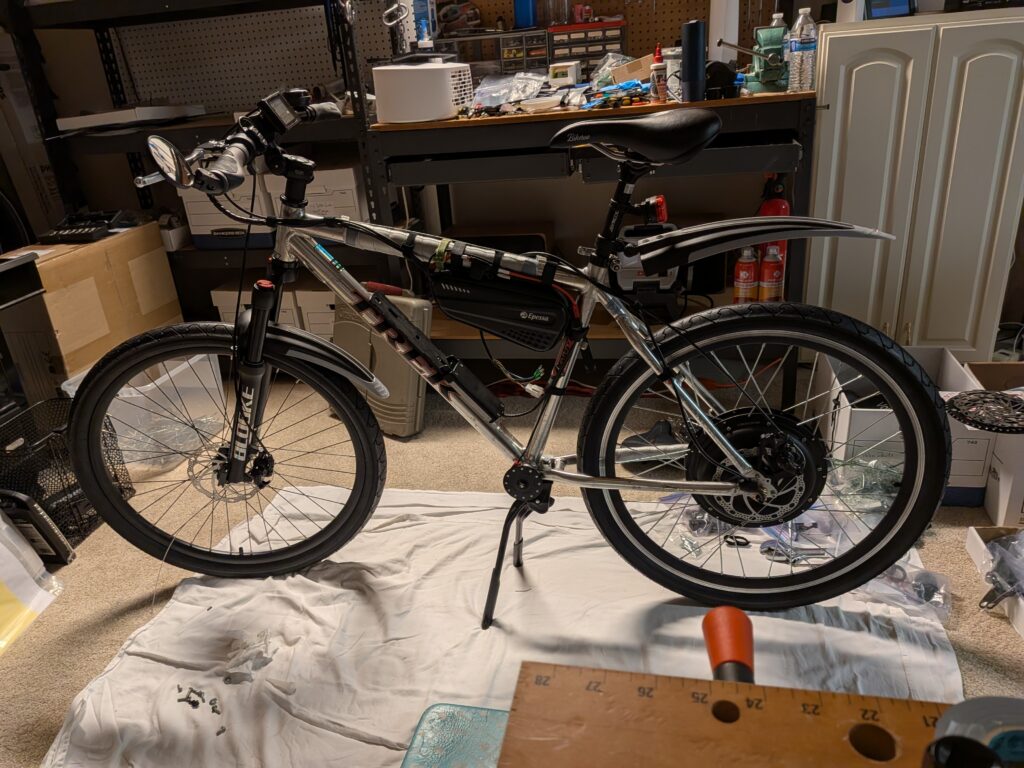
Here’s my starting point for this (re)build:
Then to get started I needed a few new items. And with a budget of $200 for new parts for the complete build I have so far spent ~$165. I’ll include a list of recycled and new parts below once the build is complete, but so far this is looking like a very inexpensive build (because I already own all the expensive stuff – frame, motor, wheels, brakes, front fork, battery, etc.).
Stay tuned as this build comes together…
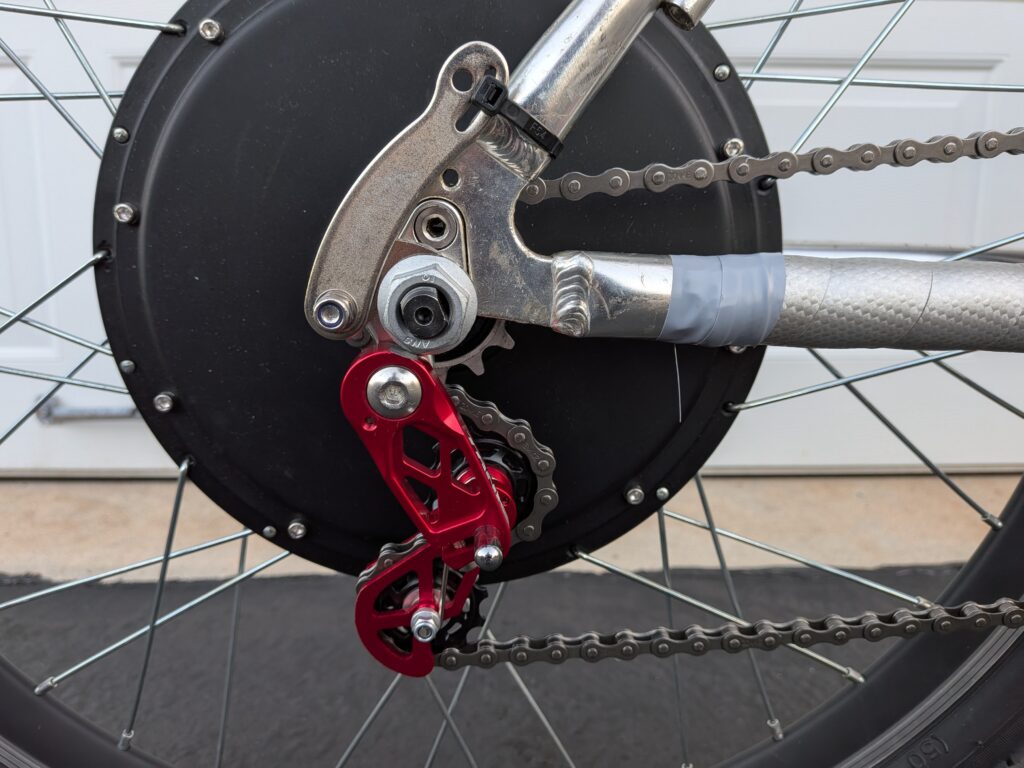
PS – For simplicity (and expense), I’m starting out with a 14-tooth single-speed sprocket, tensioner and chain salvaged from my Red Rocket experiment. This might not last since all I need to buy is a new derailleur to go from single- to 7-speed, which is desirable for PA hills. But since I still own Red Rocket, having a single-speed in the stable seems like a good idea. Also, unlike Red Rocket, Frankie will have PAS. Again, one of the real benefits of DIY e-bikes is being able to try something, then improve/fix it as needed!
** update **
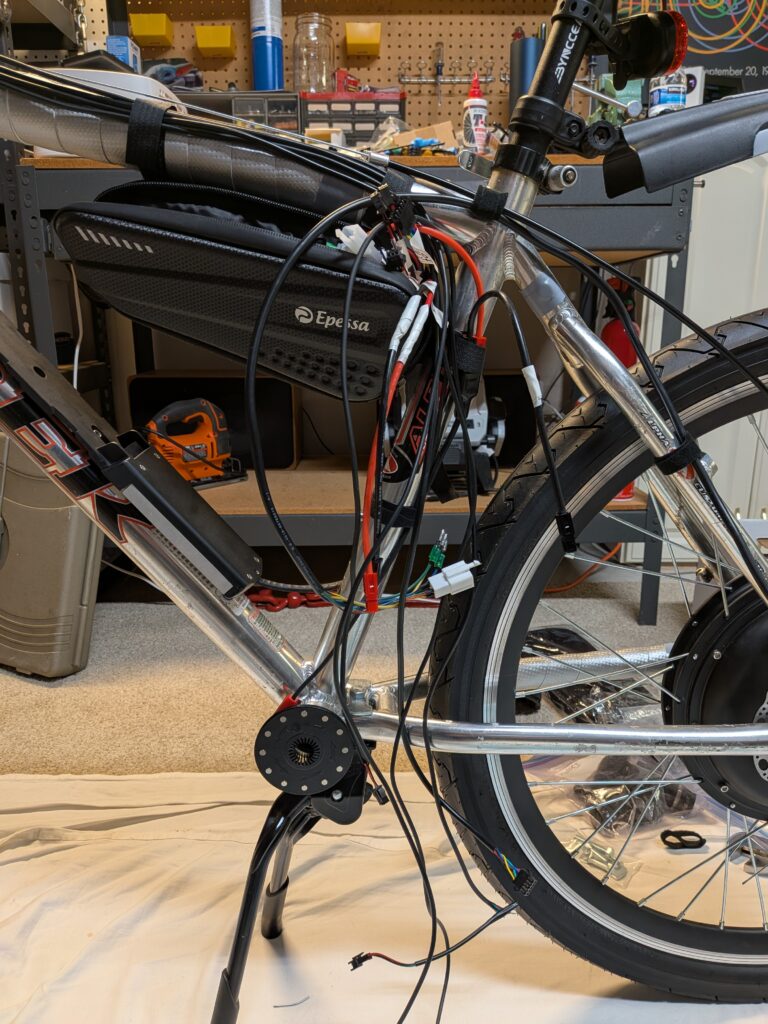
One of the more daunting parts of e-bike building and wire and cable management. With my Frankie build nearing 80% compete, here’s what I mean:
Cables, cables everywhere. What to do?
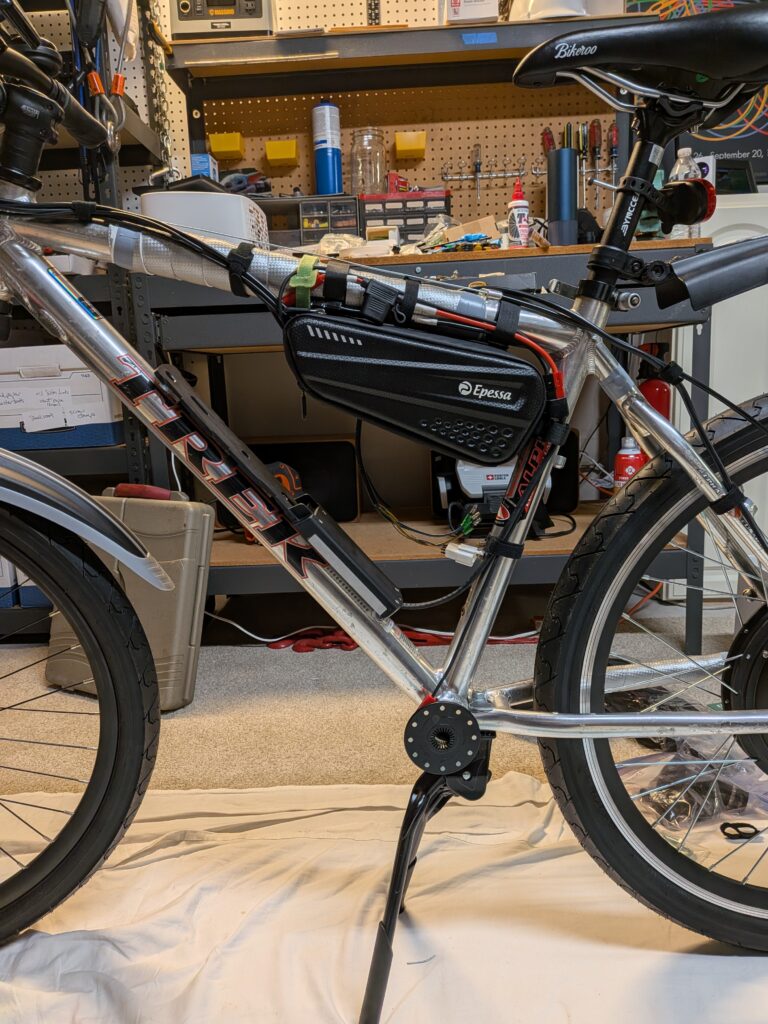
With a good storage bag and a bit of persuasion, this wire explosion finally looked like this:
Not bad! The controller and all wires find their final resting place here. I still need to connect and tuck the rear motor wires in once I get my bottom bracket and deal with chain alignment for the single-speed sprocket. After that, everything needs adjusting, tightening, then testing. There’s still some distance to run before this race is over, but just to show that real progress is being made, here’s this morning’s update (still at $165 for new parts – I’m very happy about that!):
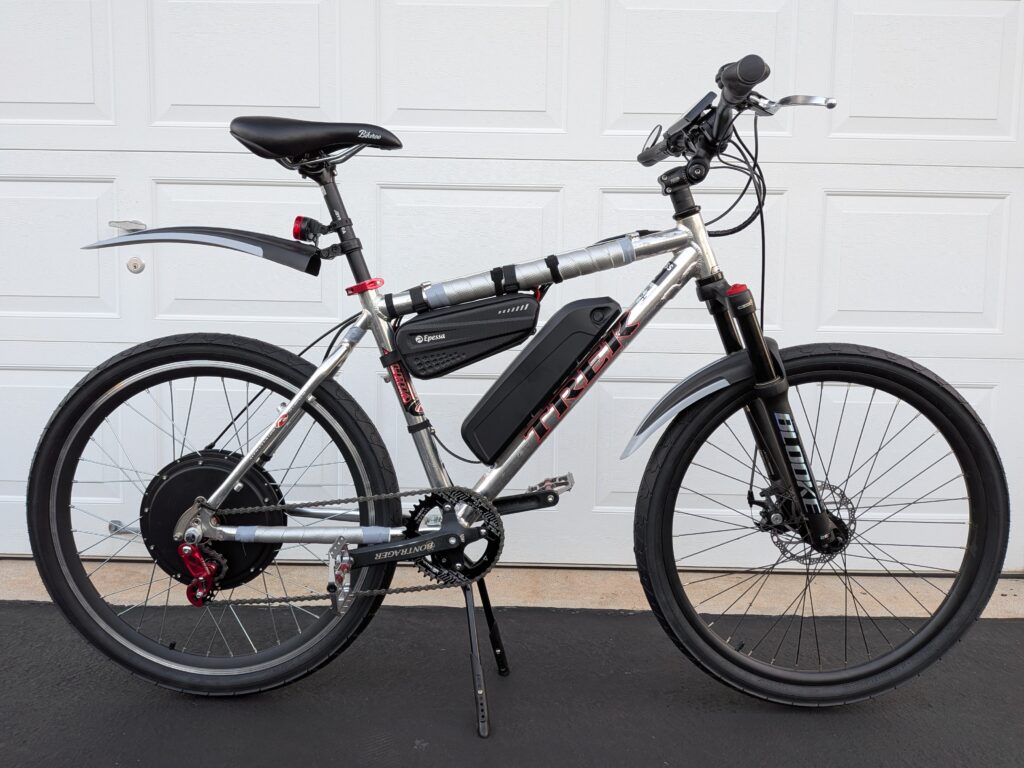
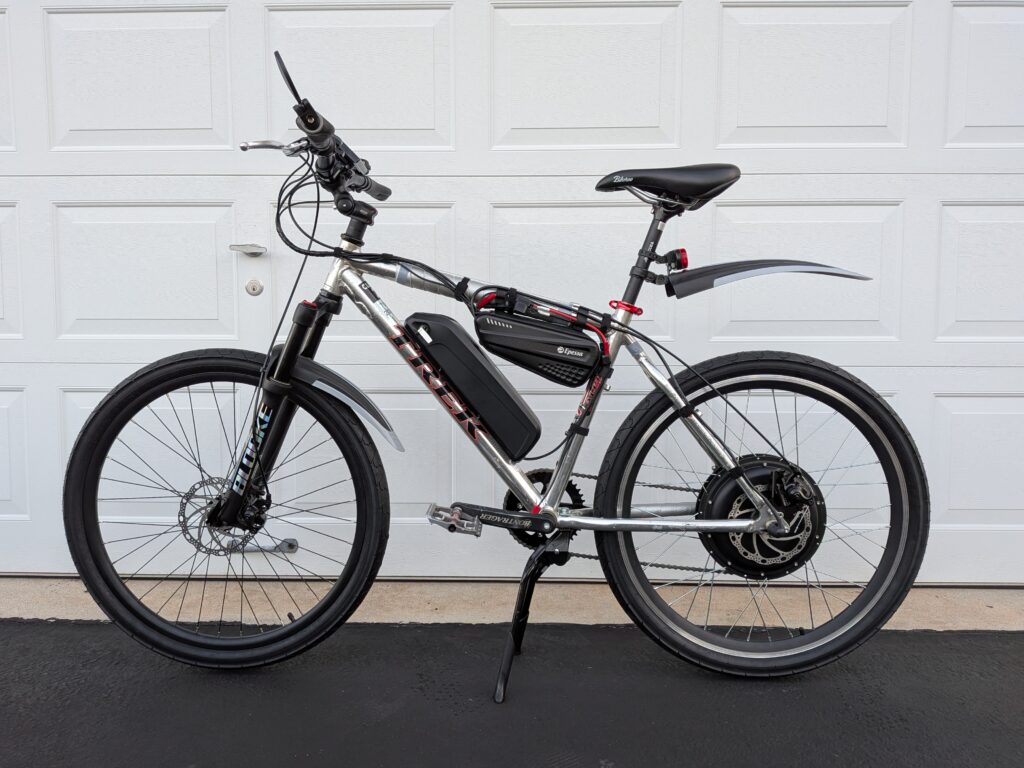
It’s October 4 and behold my creation!
My only compromise was the omission of PAS. Turns out to get the proper chain alignment I had to resort to a bottom bracket (116mm) that doesn’t have sufficient left-side clearance for the PAS hardware. But based on the way I intend to use this bike, that’s really a non-issue. This is a bike first with throttle assist.
I have yet to take this one out for a test ride but will report how I feel about riding a single-speed versus gears.
** update **
This e-bike is amazing! No, I’m not converting my other bikes to single-speed because gears are useful, though “not necessary when you have enough power”. Yes, you can quote me on that point. Here’s how I justify it. When riding with gears (and a motor of course), you shift to maintain pedal cadence. This just makes sense and works well for e-bikes. But take away the option to sift gears and you maintain speed and cadence by adding power via the motor. It works and it’s actually fairly natural once you adapt.
Here’s a list of new items required to complete this build:
Bottom Bracket 12
Headset bearings 10
Rear disc brake adapter 19
Handlebar 25
Adjustable stem 20
Grips 9.50
Seat post 14
Seat post quick release 8
Front wheel true 15
Tires 40
Cell phone holder 6.50
And many of the items I already had on hand that made this build so cost effective:
Frame, battery, motor and rear wheel, controller and display, controller bag, front wheel, tubes, rim strips and FlatOut, brake discs, calipers and cables, front fork, brake levers, crank, chain ring and pedals, single freewheel, tensioner and single-speed chain, center stand, fenders, seat, mirror, and bell. I’m sure there’s more, but that seems like a pretty good list to start with. I still can’t believe I had this much usable gear hanging around in boxes! Impressive…
Posted inUncategorized|Comments Off on Frankie Reborn
So you just bought your nifty new e-bike and you’re making plans to ride it on your local trails. You researched your trail’s rules and you know bicycles are permitted, but are e-bikes allowed? And the answer is always “maybe, or maybe not” – it depends.
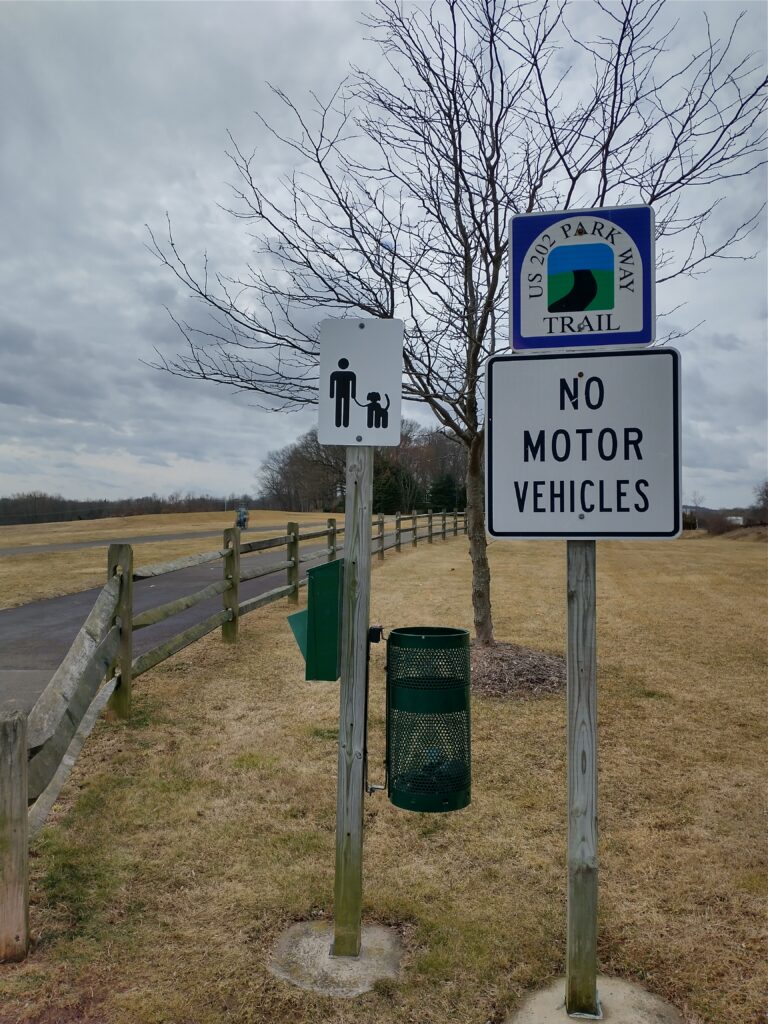
Initially, at the trail head you may be greeted with a sign that says something like this: “NO MOTOR VEHICLES”.
But don’t be overly concerned since this sign is intended to keep things like cars, motorcycles, ATVs, etc. off the trail. But this doesn’t mean you won’t be confronted by your friendly neighborhood ‘Karen‘ who insists it applies to e-bikes as well. But you can calmly and respectfully explain that Federal and State laws consider your e-bike to be a regular bicycle (assuming you’re riding a Class 1 or 2 e-bike – more on this in a moment), and if a bicycle can use this trail, you can too. Just see how that explanation flies – usually not well…
But here’s the rub. Many ill-informed municipalities instead feel the need to post signs that specifically prohibit e-bikes on their paths.
And these are usually unenforceable because they try to stretch their existing ordinances to include e-bikes within ‘vehicle’ or ‘recreation vehicle’ prohibitions. Class 1 and 2 e-bikes are NOT recreation ‘vehicles’. Then there are many trails that are explicitly Class 1 e-bike trails. Class 1 means pedal assist only, no throttle. But most e-bikes on the market have throttles pre-installed. In this case, you must either disable or remove your throttle before using these trails. Also, Class 1 and 2 e-bikes are capped at 20mph. so if you have taken steps to remove this limit, you’re no longer ‘legal’ on these trails.
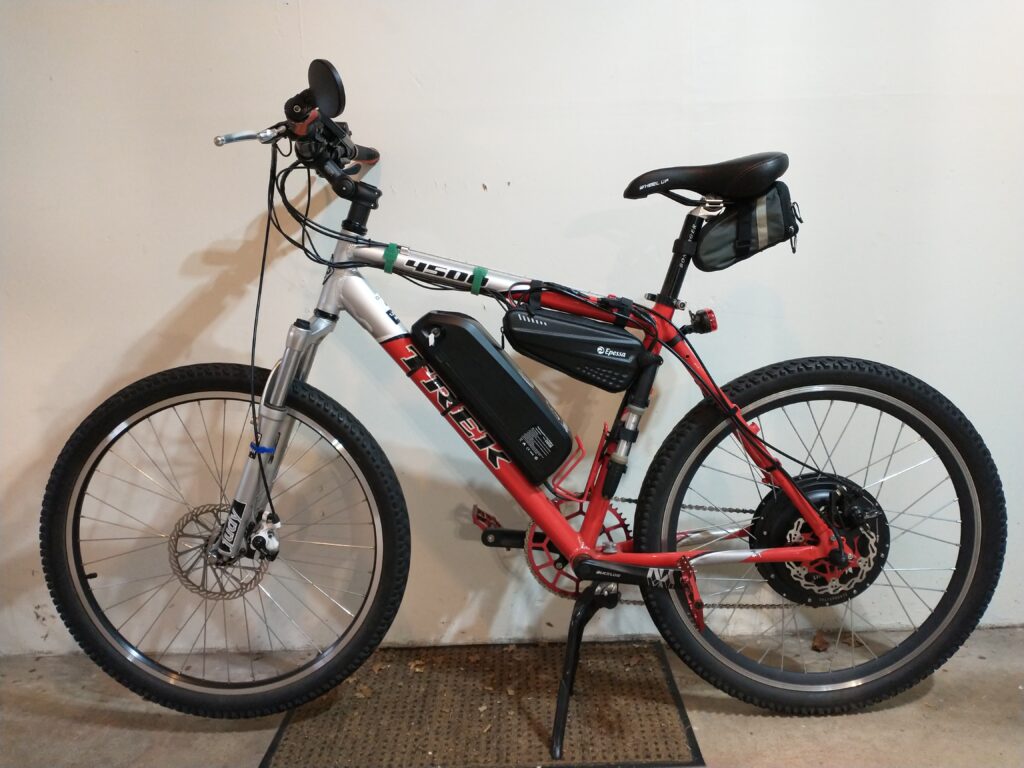
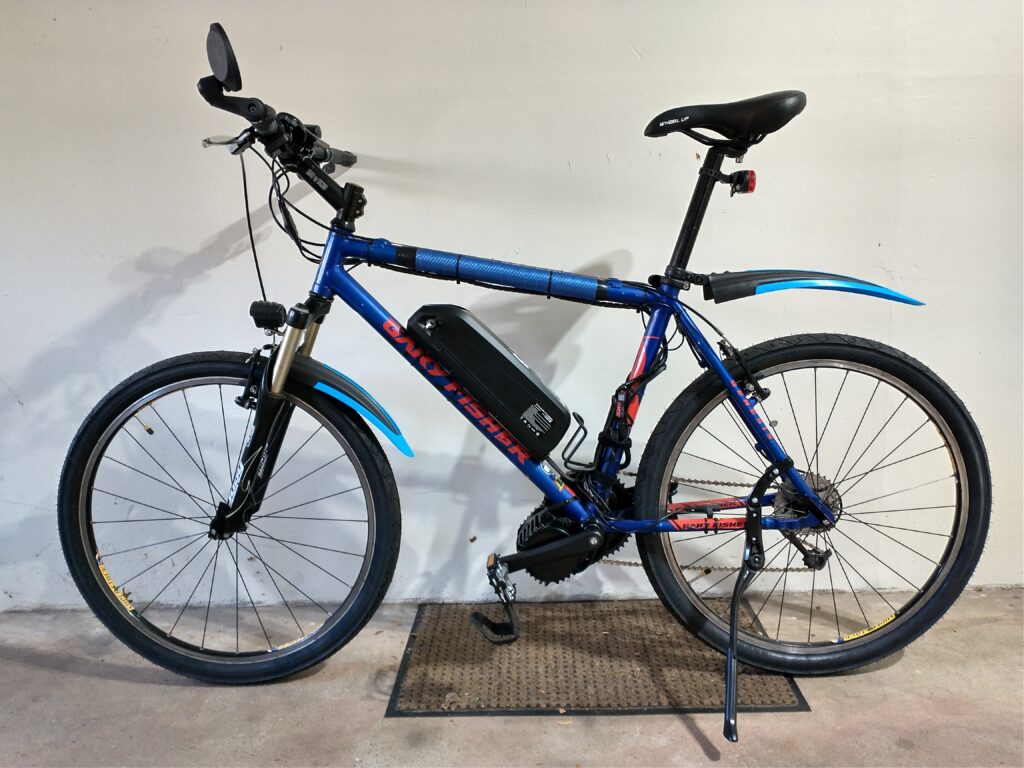
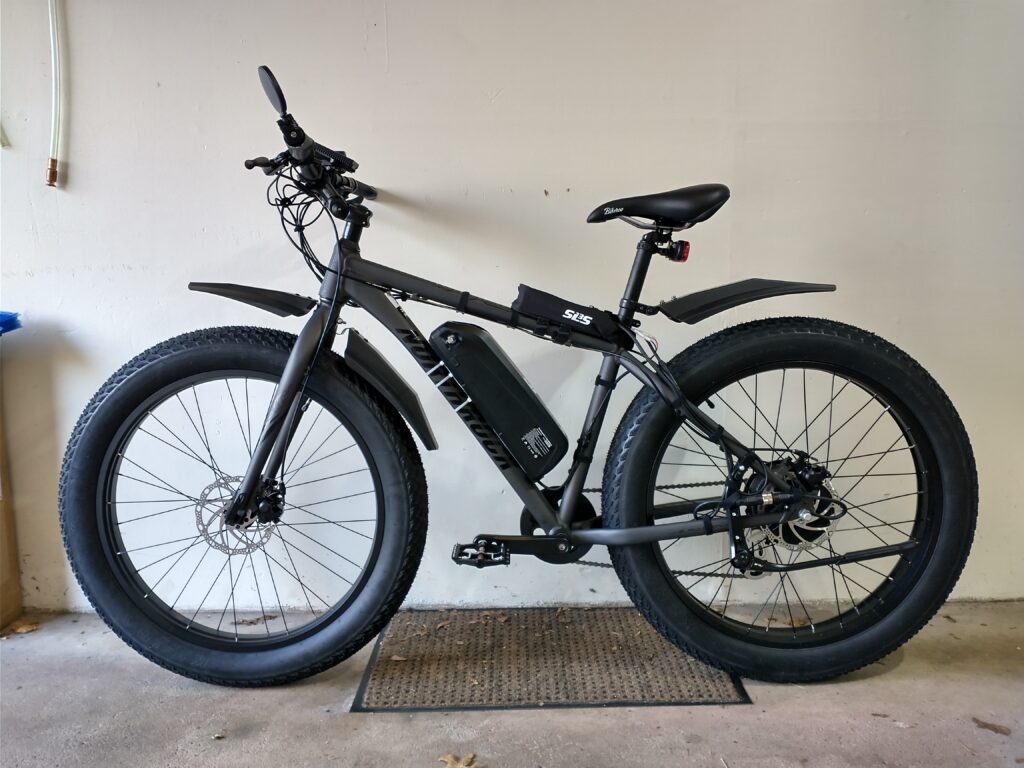
So, let’s get personal. I have 6 e-bikes as I write this post. 5 are completely custom and 1 is a Class 2 factory bike. And considering what I just wrote about e-bikes being ‘legal’ on local trails, only 1 of mine is actually LEGAL (currently)! Is that a problem? Yes, it could be. But most likely if I’m obeying speed limits and stop signs, and behaving myself on the trails (as in, nobody is going to need to criticize my ‘trail etiquette‘), then all of my bikes should be acceptable (though still not technically legal). So let’s take inventory and see why most of my bikes aren’t legal:
Red Rocket – No PAS, throttle only, 1000 watt rear hub motor (legal e-bike motors are capped at 750 watts), speed unlocked to 28+ mph (not Class 1, 2, or 3 – too much power, no PAS)
No remedy – too powerful, too fast, no PAS
2. Blue Wave – PAS and throttle, 1000 watt mid-drive, speed unlocked (too much power)
Remedy – reprogram motor to 750 watts, restore max speed to 20mph – Class 2, or Class 1 with removable throttle just added
3. Fatty III – PAS plus throttle, 1000 watt rear hub motor, speed unlocked (ditto)
Remedy – reprogram motor to 750 watts, restore max speed to 20mph – Class 2, or Class 1 with removable throttle just added
4. Silver Fox – No PAS, throttle only, 500 watt rear hub motor – full suspension (should be able to pass as Class 2, but no PAS)
Remedy – add PAS – Class 2, or Class 1 with removable throttle just added
5. Himiway Cruiser (factory) – PAS, throttle, 750 watt rear hub motor (Class 2 locked at 20mph – totally legal, or Class 1 with removable throttle that comes standard with this bike)
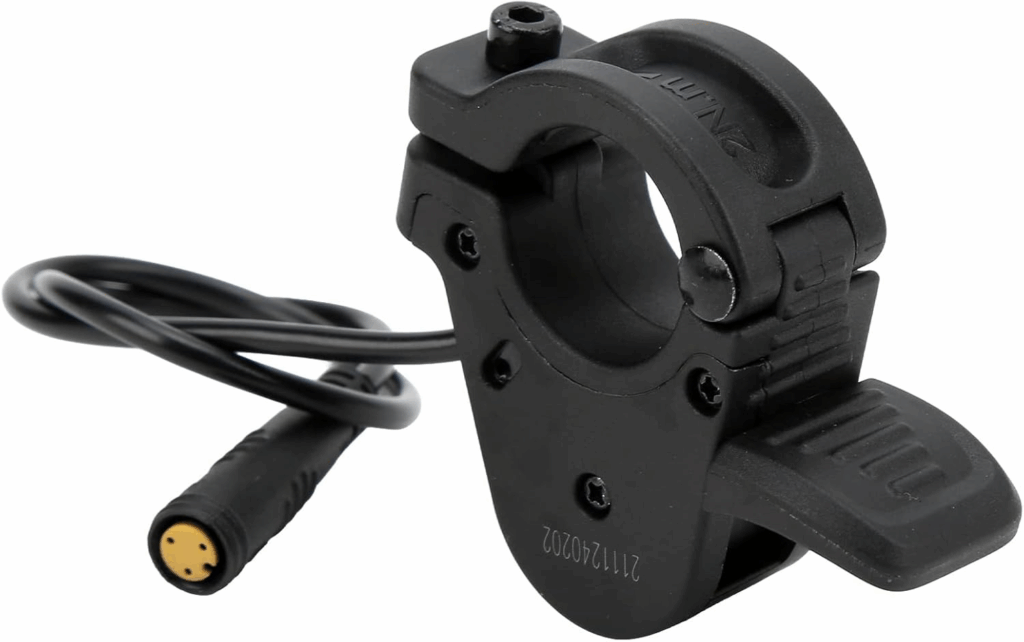
This is the ‘removeable throttle’ added to #2, 3, and 4 which means each of these bikes can be made into legal Class 1 e-bikes in a matter of minutes as long as the other issues are addressed.
And a recent addition to my fleet:
6. Frankie – No PAS, throttle only, 1000 watt rear hub motor, speed unlocked to 28+ mph (not Class 1, 2, or 3)
No remedy – too powerful, too fast, no PAS
Here are the real issues for those who actually ride e-bikes (which often doesn’t include those making policy decisions):
The e-bike demographic is tilted toward older people who probably wouldn’t be riding a bicycle at all if it didn’t provide assistance for hills.
Many bicycle and e-bike riders don’t ride only on trails, but often need to ride on streets to get to their local trails. Being able to go faster than the normal trail limit of 15, or even 20mph in some cases, is often useful when riding on local streets.
Pedal-assist simply isn’t enough for all situations, like starting out from a stop to cross a busy street, starting on a hill, etc. This is where throttles are not only useful but are an essential safety feature in my experience.
E-bikes normally have wider tires with less tire pressure (2.4″ to 4″ is normal, and 20 to 60 lbs pressure). This makes riding an e-bike more comfortable and safer than riding with higher pressure, narrower tires.
E-bikes are heavier and sturdier than regular bicycles so adding safety devices like mirrors, bells, lights, etc. is appropriate since overall weight isn’t usually as big a deal than it is with regular bicycles.
In closing, I’m going to put in a plug for the e-bike configuration I find most enjoyable to ride regularly and that includes my ‘throttle-only’ e-bikes. I like riding my e-bikes like regular bicycles, then supplement power as needed using the throttle. This way of riding isn’t every rider’s cup of tea, but it works for me. When you add PAS, then you’re always getting assistance which makes me work less and drains the battery more quickly – both negatives in my mind. And yeah, that means these throttle-only e-bikes are probably not entirely legal in most places. Bummer!
Posted inUncategorized|Comments Off on Legal or not?
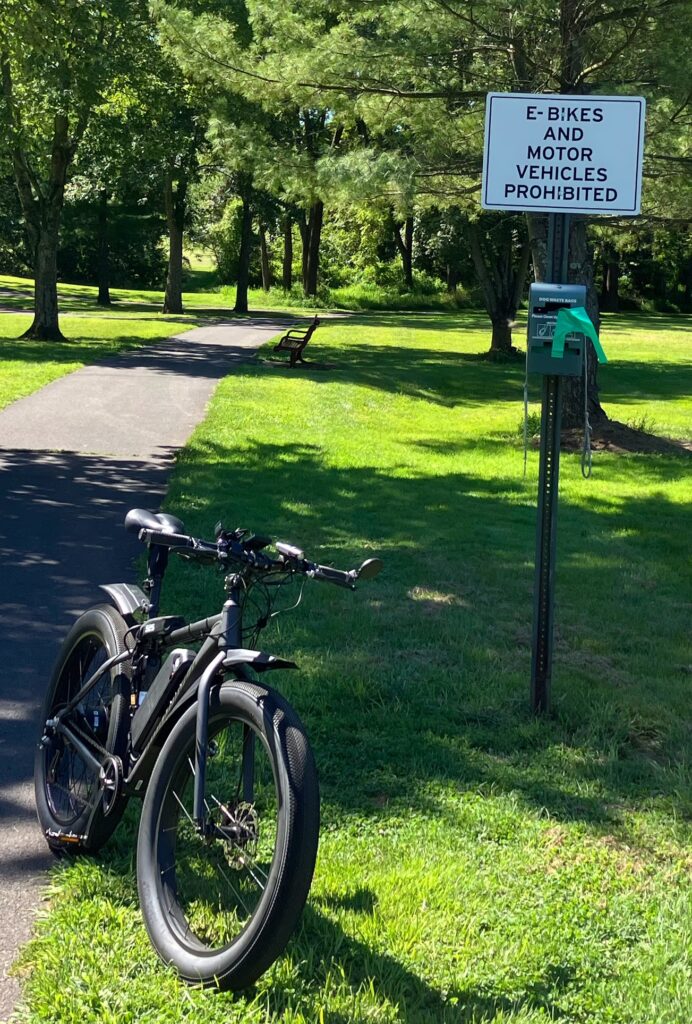
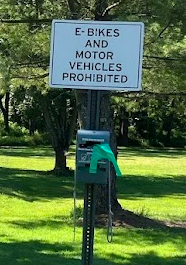
I live in Sellersville, PA and the only real ‘bike path’ in the area goes through the town of Perkasie and East Rockhill Township. Recently this sign went up at one of the entry points to the trail:
Before this, the only signs that were displayed anywhere read only ‘Motor Vehicles Prohibited’, which is fine because Federal and State law consider Class 1 and 2 electric bikes as regular bicycles, not ‘motor vehicles’. But this is different, and makes no sense at all.
So why would our local jurisdiction(s) do this? Here’s why (source):
“The Perkasie Borough Police Department has noticed a surge in reports concerning minors operating electric bicycles. Many parents are unaware that, according to Pennsylvania law, individuals must be at least 16 years old to legally ride an electric bike. It’s essential to note that electric bicycles are classified as vehicles in Pennsylvania and, as such, are subject to specific laws and regulations. Furthermore, their use is strictly prohibited within Perkasie Borough’s parks and bike paths.”
So let’s take this statement apart one piece at a time:
“Minors operating electric bicycles” – that’s definitely a thing that’s happening and needs to be better controlled. But will putting a sign up like this help – maybe?
“Electric bicycles are classified as vehicles in Pennsylvania” – no, they’re not!
Pennsylvania Definition: An e-bike in Pennsylvania is a bicycle with an electric motor, max 750 watts, that is capable of propelling the bike up to 20 mph, and must have fully functional pedals.
Classification:E-bikes meeting these criteria are treated as bicycles under the law, not as motor vehicles.
General Rules for E-Bikes
Age: You must be at least 16 years old to operate an e-bike.
Registration & Licensing: No special license, registration, or insurance is required for e-bikes.
Road Use: E-bikes are permitted on roads and bike lanes, and riders must obey all traffic laws, the same as cyclists.
“Their use is strictly prohibited within Perkasie Borough’s parks and bike paths” – because they say so. There is no other good rationale, except to keep renegade kids off the trails. AND there is no supporting ordinance to back this up!
And finally, Perkasie includes a link (E-Bikes in PA) in their message to the DCNR recreation page which states:
“E-bikes are allowed on trails already open to traditional bicycle usage as long as users follow guidelines consistent with the Pennsylvania Vehicle Code that e-bikes:
Weigh no more than 100 pounds
Do not exceed 20 miles-per-hour using the motor
Have motors that do not exceed 750 watts
Have fully functional, operable pedals
E-bikes can be used on DCNR-managed trails where traditional bikes are allowed.”
So what’s really going on here? Kids! They’re doing what kids have always done, but now with new, more powerful equipment, and in congested areas where people and pets are in danger. Kids have parents, and this really is a parenting problem first and foremost.
So what’s to be done about it? NOT, and I repeat, NOT a ban on responsible individuals riding electric pikes on trails where federal and state laws permit it. That’s just dumb and short-sighted. What I propose first is going back to the original “No Motor Vehicles” signage. That is intended to keep ALL ‘vehicles’ off the trail that don’t comply with federal and state laws. And maybe a brief explanation of what those laws state should be included on these signs to better inform.
Second, create a voluntary safety training and registration process for responsible electric bicycle owners. Once registered, permission to use local trails will be granted so long as the rider operates equipment covered by federal and state law AND obeys all applicable laws when operating on trails and streets. This is essentially a get out of jail free card while operating an e-bike in a place they should be able to legally ride anyway.
Third, impound EVERY e-bike that is operating illegally on streets and trails, and fine the parents when it involves a minor. Every parent will claim they didn’t know about the law and that they had no idea their lovely child was doing such lawless things with their new toy. Don’t buy the excuses. This stuff is all over the news so they ARE aware…
Fourth, get responsible riders back on the bike paths in Perkasie and surrounding areas. MOST riders are responsible and I dare say most e-bike riders ride slower than their non-motorized counterparts. Many of us even ride without power most of the time because the trials are flat and don’t require the extra power. Question: If I’m riding an e-bike with Power Off, am I still riding an e-bike? Probably yes, but I asked this to a guy who was doing exactly this and he claimed he was OK on the trail because he had power turned off. Interesting…
The other reason for keeping responsible e-bikes on the path is for safety. More trail users make for a safer trail for everyone. We look out for each other, interact with each other, and can respond quickly if there’s an issue.
And finally, everyone, regardless of conveyance should act safely and responsibly. I propose an informal and voluntary safety classification for bicycle and e-bike riders where riders can get some medical response training and understand all the rules of the road so they can coach others on safe practices if they see someone doing something crazy and unsafe. When training is complete, not only can these individuals use bike paths that might otherwise be restricted, but they would also receive a reflective vest they would be expected to wear at all times on the trail. This would give others the confidence that these people are supposed to be here and they can request assistance if desired. I think this would be a welcome thing if it meant trails in the area are no longer off limits, and participants could be of service to their community as well.
I’m going to stop here. I’m REALLY bothered by dumb knee-jerk reactions to kids being stupid on these mini pocket rockets, and their clueless parents. But the onus is on Perkasie and East Rockhill administration to figure out how to deal with the real problem while not penalizing the 98% of us that are doing nothing wrong or illegal. And they’re not alone. Many communities are trying to deal with this same issue, so I understand. But let’s think this through and come up with some better solutions.
** Update **
Remember that picture I showed at the beginning of this post? The one that says “E-Bikes…Prohibited”? Yeah, that one. Well now there are 3 signs in total, all in East Rockhill Township. However, this is interesting because East Rockhill Township doesn’t have an ordinance that addresses e-bikes specifically. Their Ordinance § 15-1202 addresses “recreational vehicles” which they seem to want to apply to e-bikes as well. The ordinance includes examples of recreational vehicles (which includes neither bicycles nor electric bicycles) and goes on to say: “Recreational vehicles shall not be operated on any sidewalk or within the right-of-way of any public or private street being maintained or used as a thoroughfare for legally licensed vehicular traffic unless the operator has a valid operator’s license and the recreational vehicle is properly registered and licensed with the Commonwealth of Pennsylvania as a motor vehicle.”
So by East Rockhill grouping e-bikes into the ‘recreational vehicle’ category, e-bikes are not legally permitted to operate on trails OR public roads. So you see the issue here, not just for the inconvenience to the e-bike owner, but for the enforceability of the ordinance and associated signage? Since federal and state law consider Class 1 and 2 e-bikes to be bicycles, by definition they fall outside the ‘recreation vehicle’ category and must be considered legal on these trails regardless of the signage.
And for that matter, Perkasie has similar rules about ‘vehicles‘, and by grouping e-bikes under this heading feel they can exclude vehicles of ANY type from using their trails. They haven’t posted signs as East Rockhill has, but the police CrimeWatch site states specifically that e-bikes are considerd ‘vehicles’ and are thereby restricted from using Perkasie trails. Here again, I have a hard time believing that they can actually enforce their rules unless someone on an e-bike is doing something blatently stupid or illegal (remember, ‘bicycles’ are held to the same standard as other vehicles on the road and can be cited for breaking vehicular traffic laws).
** update – Doylestown figured this out and is doing it right! **
A few years ago, while living in the Doylestown, PA area, I attended a few Bike and Hike Committee meetings (Meetings are held on the 3rd Tuesday of each month at 8:00 am in the Caucus Room at the Doylestown Township Municipal Building). At the time there was growing interest in dealing with the surge of electric bicycles, as well as other electric conveyances like electric skateboards, scooters, one-wheels, Segways, etc. The result was a revised ordinance published in 2023 for the Bucks County Parks System entitled Ordinance No. 170 as well as ongoing work on a Doylestown Township draft “Trail User Code“. Excerpts from both follow:
ORDINANCE NO. 170 – Enacted January 18, 2023
S7 Operation of Bicycles, E-bikes, and E-scooters
And the Doylestown Township draft “Trail User Code”
Welcome back! Maybe you had a chance to read my previous post, A Perfect Lady’s E-Bike!. If so, I want to now describe the difference, in my mind, between a ‘lady’s e-bike’ and a ‘man’s e-bike’. But before I begin, I know there will be little agreement out there from either side about the merits of my argument. But I’m going to do it anyway:
A lady’s e-bike should be:
uncomplicated (simple to operate)
attractive (easy on the eyes)
light-weight (55 lbs or less w/ battery)
reliable (good components)
comfortable (cushy seat, good handlebar position, comfortable grips)
And a man’s e-bike should be:
well-constructed (good weld joints and structural integrity are important)
funtional (good power and well-designed controls)
not too heavy (75 lbs or less)
good range (60 miles on a charge minimum)
wider tires (maybe even fat-tire, but nothing less than 2.4″)
We can agree to disagree, but I’m starting here. And perhaps I should explain why I’m even talking about this. Well, a friend has asked me to sell his e-bike, and when I received it I thought immediately that this IS a guy’s e-bike. Not only that, but the PERFECT guy’s e-bike!
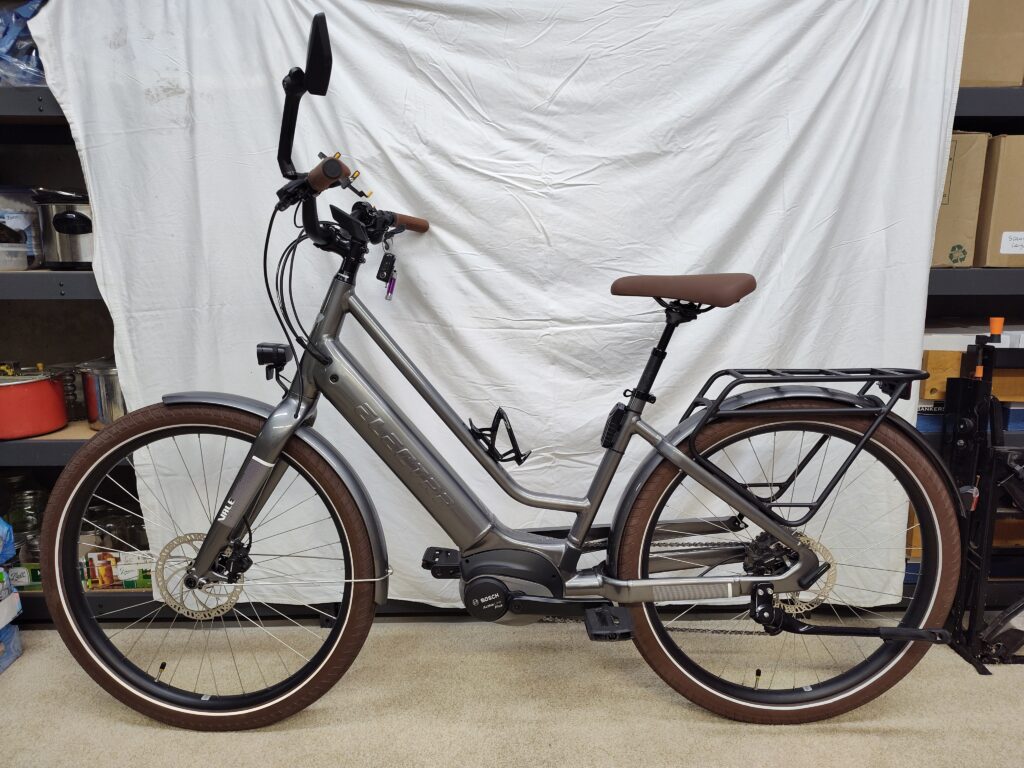
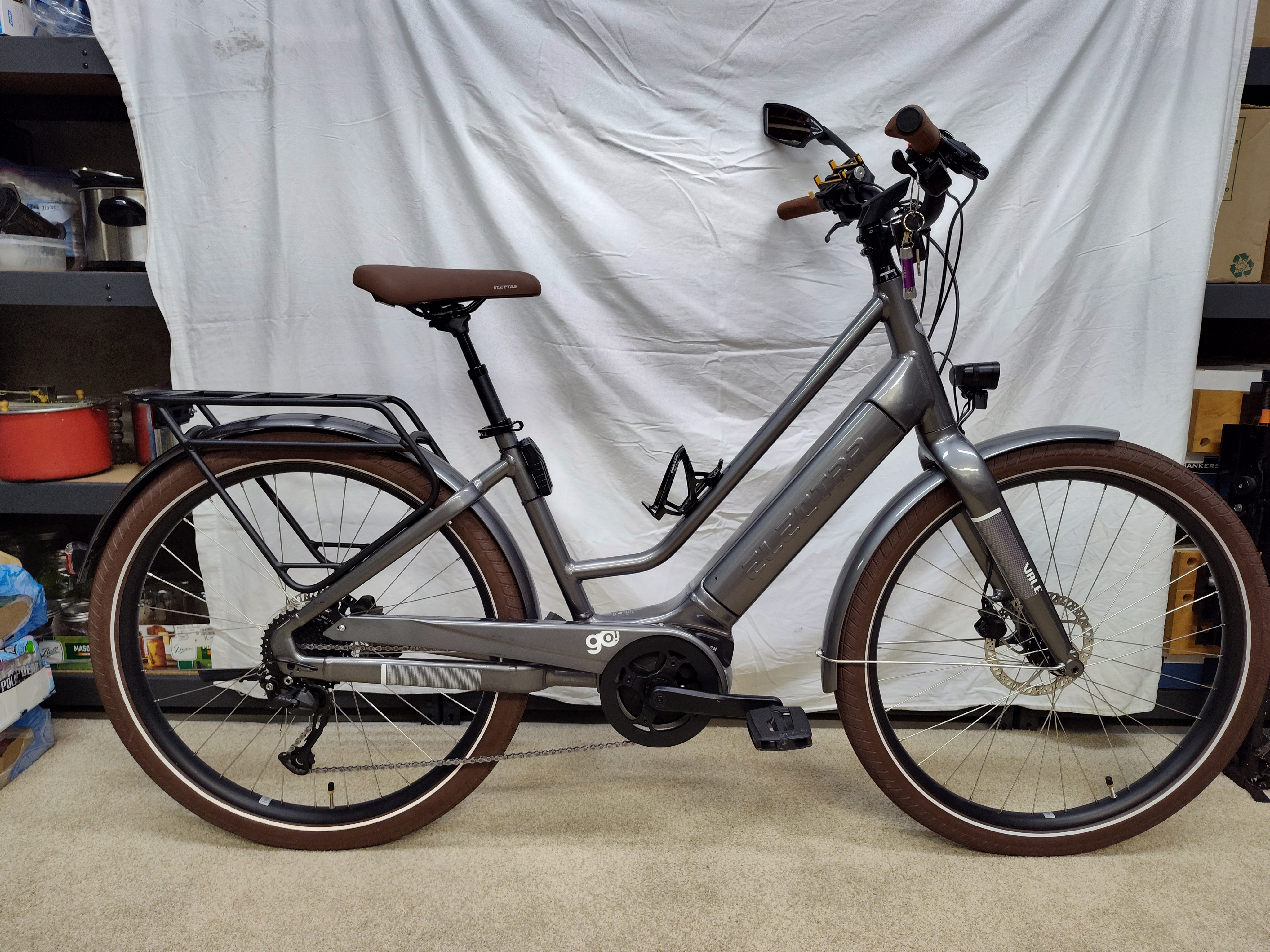
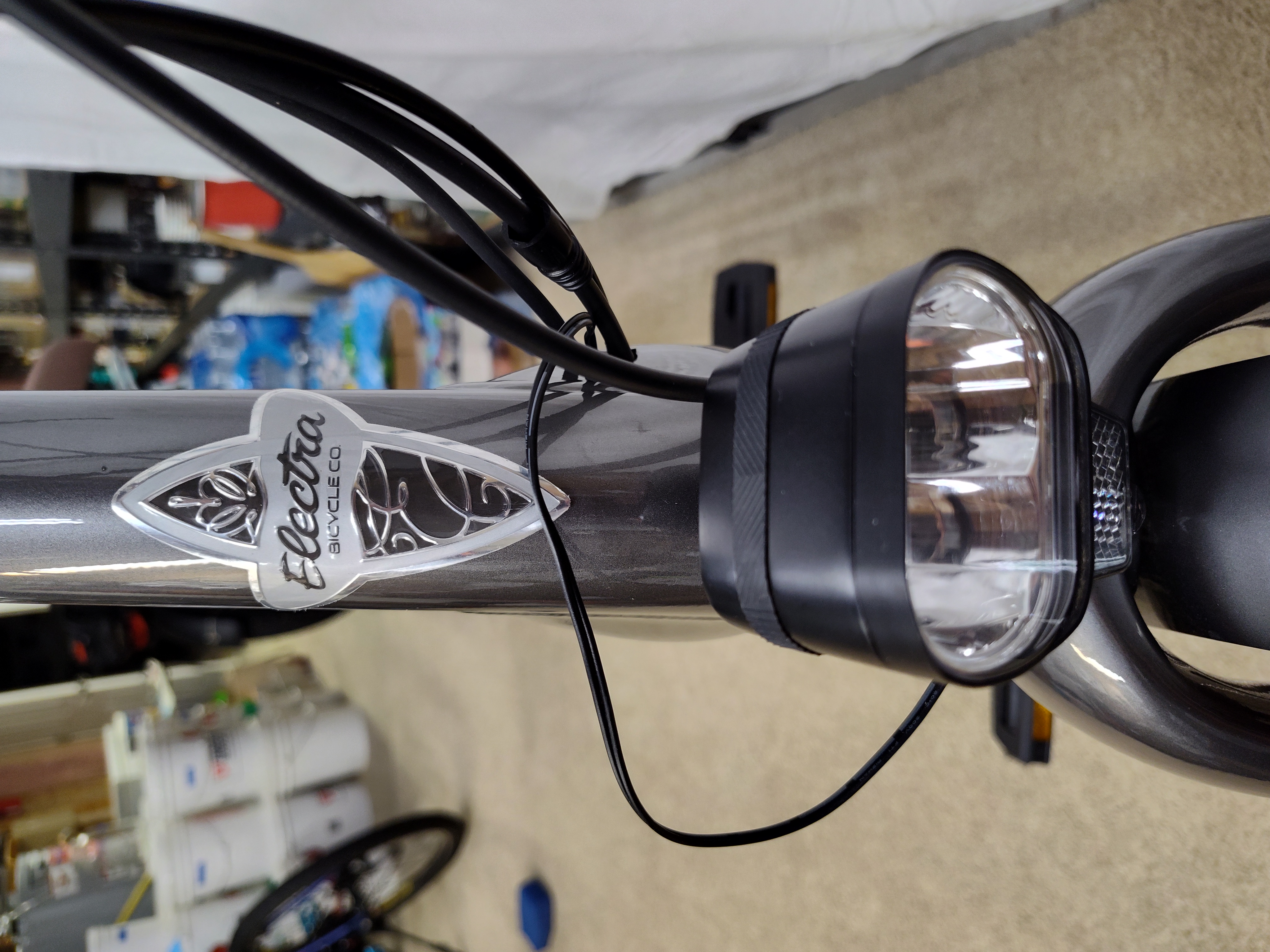
Introducing the Electra Vale Go! 9D EQ which retails for $3550, but can be purchased new for $2400, or used for about $1400. When researching this e-bike, I believe this bike is a phenomenal value at $2400, let alone a steal in the $1400 range, if you can even find one with low miles for that price. OK, so let’s get back on topic and explain why this is a guy’s e-bike.
build quality is exceptional
components are all high quality
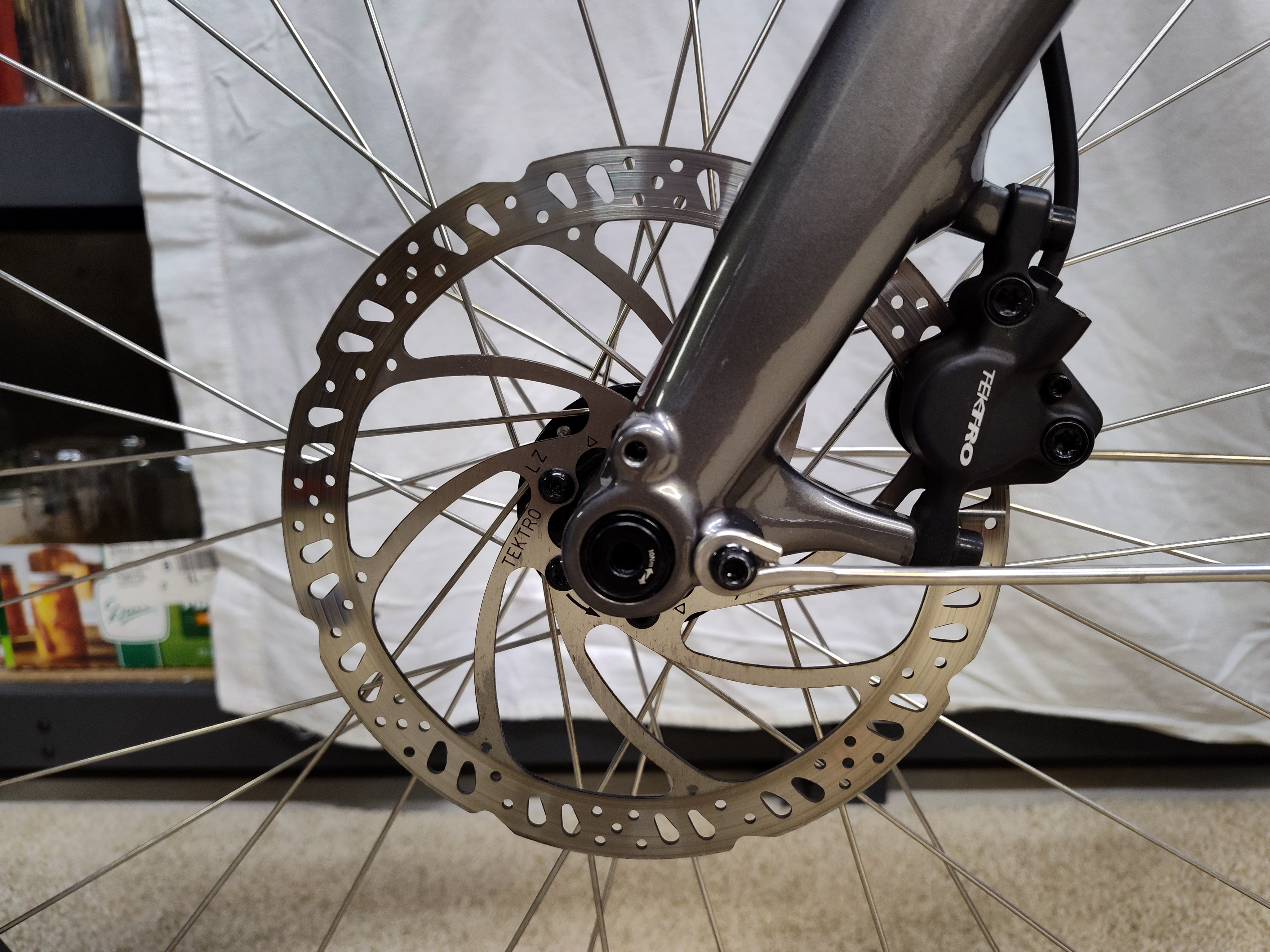
every detail has been thought thru and executed well (as you’ll see in the pictures below)
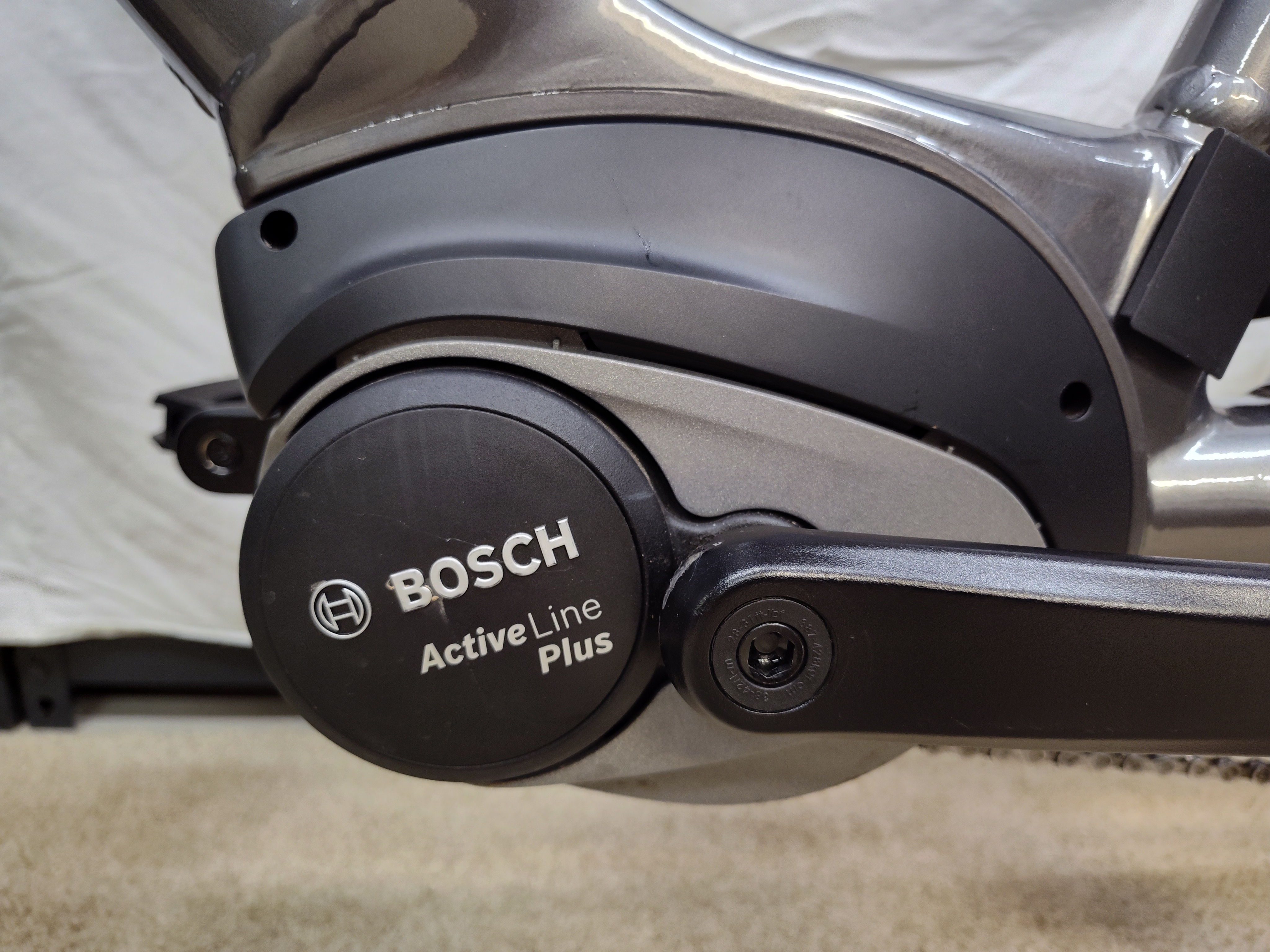
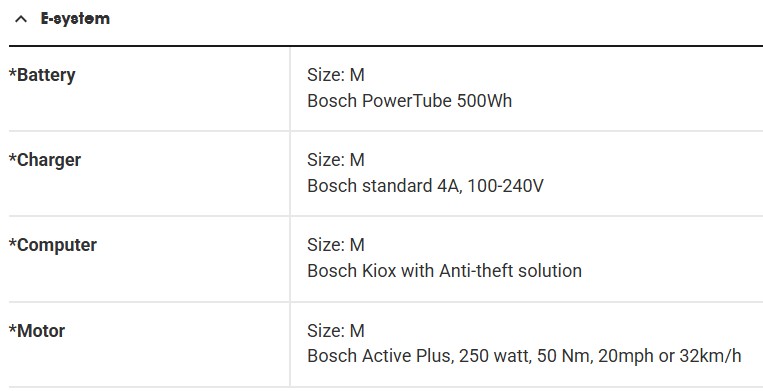
Bosch mid-drive motor (this is a $1000 part all by itself)
high-quality removable battery and good range (max. range is 75 miles)
informative removable display (easily remove the display when parked to discourage thieves)
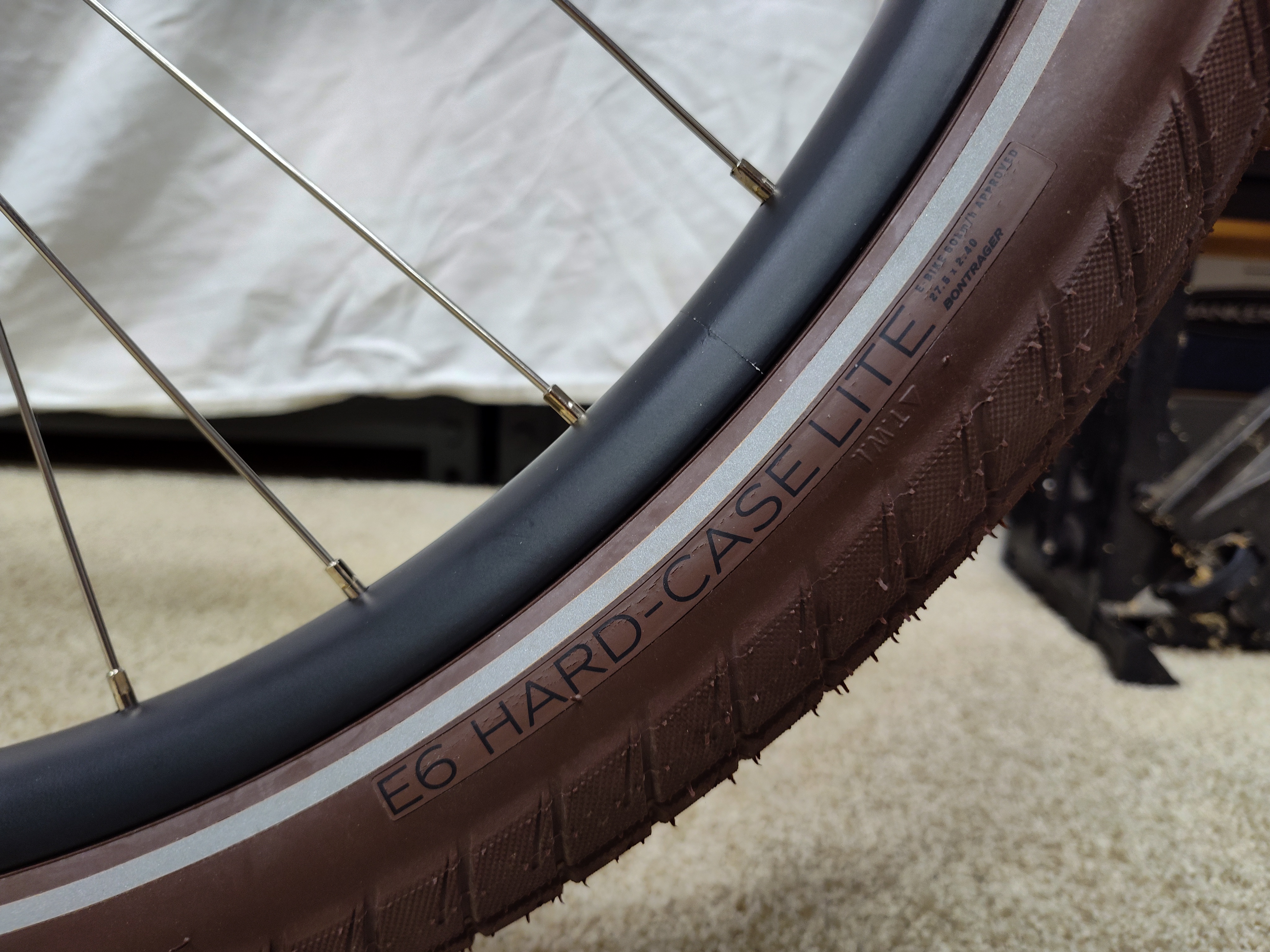
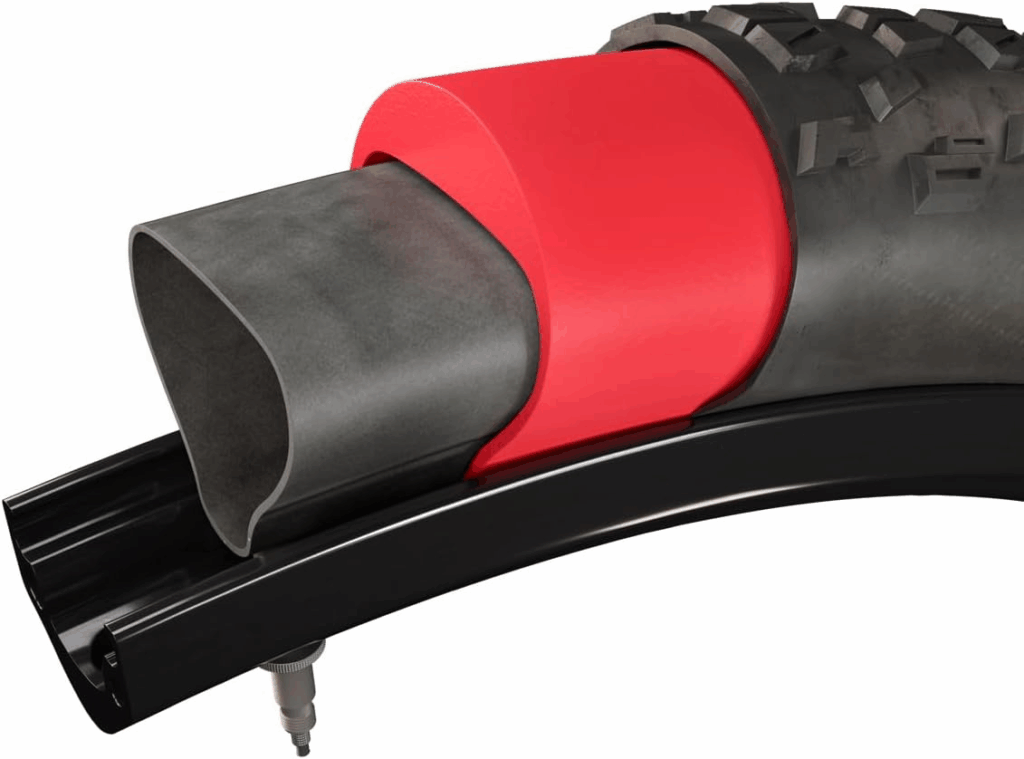
high-grade puncture-resistant tires with Tannus Armour liners (installed on this bike)
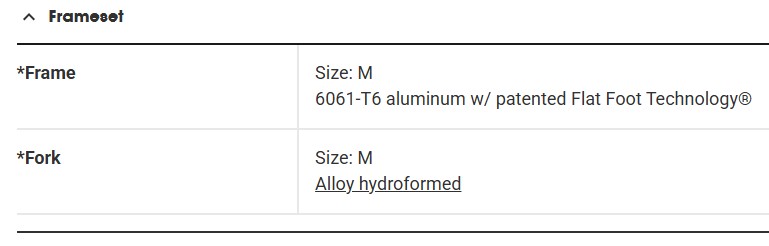
I’ll stop there and let the following images speak for themselves. But before doing that, I would not expect many female riders to really care much about some of this bike’s attributes. But I, being a guy think things like puncture proof tires, a removable display and kind of information available on the display, build quality and high-end components are really important, and this bike has all that.
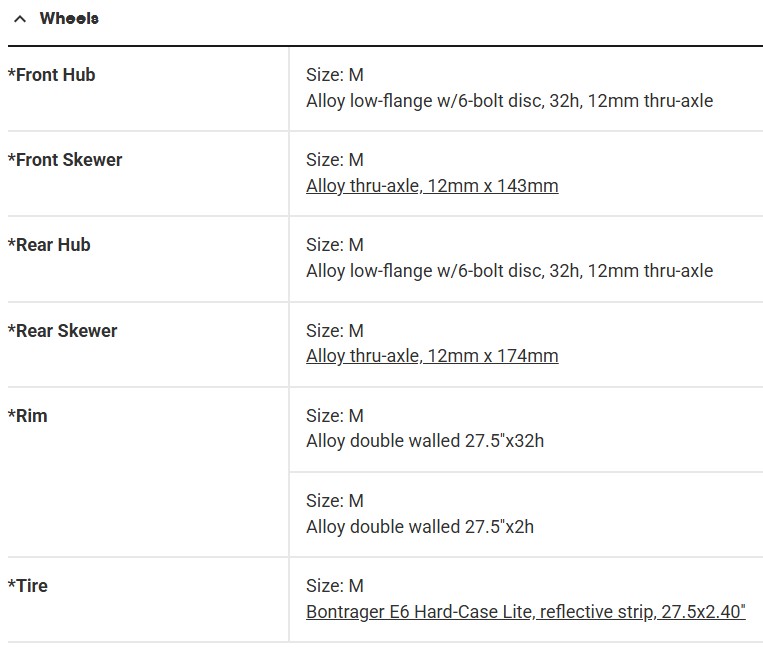
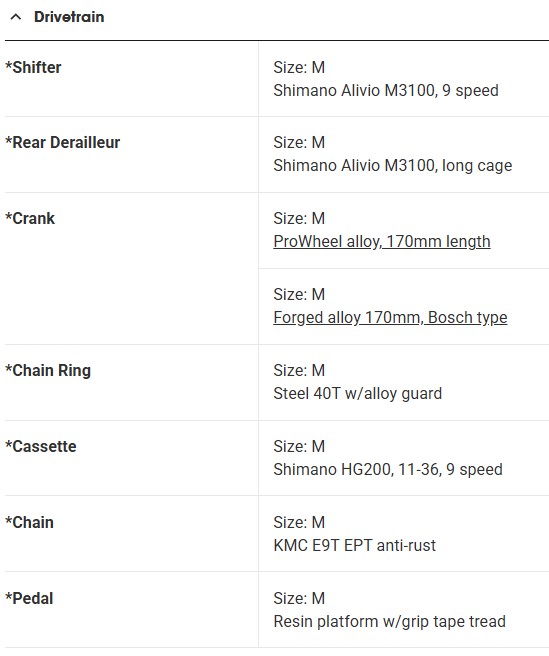
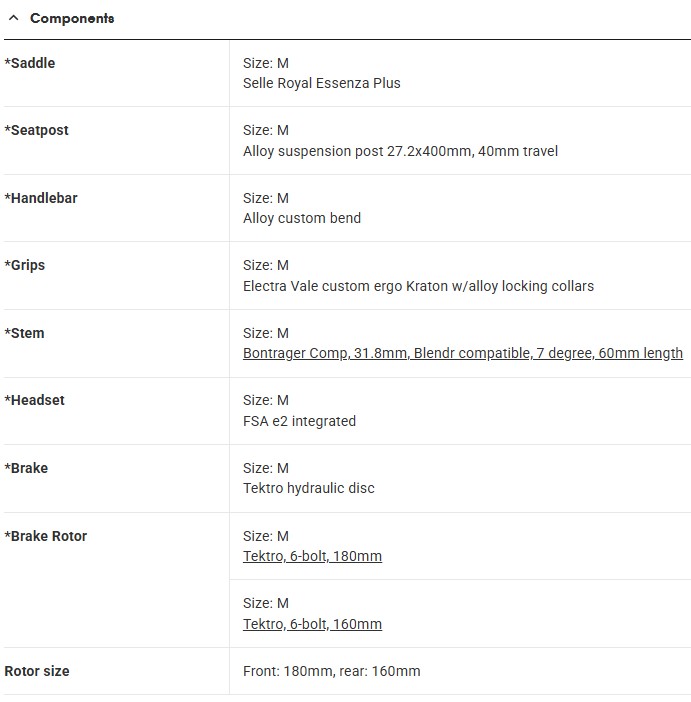
Now for the pictures and specs you have all been waiting for:
This new site has two primary purposes. First, it’s an exercise designed to help others develop their own WordPress websites. And second, it’s to communicate to aspiring DIY e-bike builders my best practices and resources that can help them successfully build an e-bike without spending a fortune.